When Imports Go Low, Security Goes High
Celebrating A 40-year Low
Earlier this month, the U.S. Department of Energy quietly released a report that is a major victory for American energy security and independence. The report revealed that in 2024, the U.S. only imported 17% of its energy supply from foreign sources—the lowest amount in nearly 40 years. That means the U.S. has halved its energy imports from other countries, mostly due to increased domestic energy production, since imports peaked in 2006. Imports from the OPEC countries decreased a whopping 77% during that same time.
This is proof positive that “Drill, Baby, Drill” and “Build, Baby, Build” aren’t just catchy slogans. They are policies that work for American families and businesses.
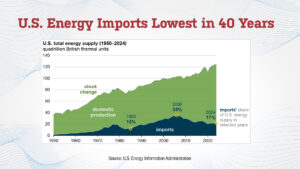
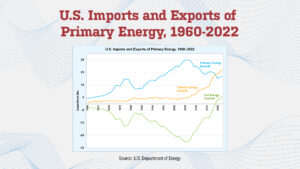
The report also revealed that the U.S. has remained a net energy exporter now for several consecutive years—meaning we are producing record amounts of energy that exceed our domestic consumption. In fact, U.S. primary energy exports have been steadily increasing since 2002. Primary energy sources includes coal, coal coke, crude oil, petroleum products, natural gas, biofuels, and electricity.
Dependent on Foreign Energy No More
The point where “primary energy imports” and “primary energy exports” cross on the graph below represents a noteworthy victory for Americans. For years we were reliant on foreign oil and other energy sources. Many Americans have grown up watching us fight wars in the Middle East and waiting in lines at the gas stations back home, while we were held hostage by a dependence on untrustworthy foreign nations to meet our energy needs.
But, that is no more. Now, we produce more than enough energy to fuel America and her people with affordable, reliable and clean American-made energy. But, not only that, now we can also export energy to support our allies around the world—creating a safer world both at home and abroad. As the Center for Liquid Natural Gas puts it, “Secure, reliable U.S. liquefied natural gas (LNG) is playing a critical role in stabilizing global energy markets, especially those in Europe.”
But, “Green” Energy Could Take Us Backward
However, we can’t just rest on these laurels. There is already a new threat that could take us back to the days of dependence on other nations that we simply can’t trust. The renewable energy sources that so many in the green-at-any-cost crowd laud, require rare earth metals and other critical minerals as core ingredients in their production.
Solar panels require rare earth metals such as yttrium or europium, and wind power uses vast quantities of neodymium in the magnets that help convert wind energy to electricity. Several rare earth elements, such as neodymium and dysprosium, are critical to the motors used in electric vehicles. And, rare earths are used in rechargeable batteries for electric and hybrid cars.
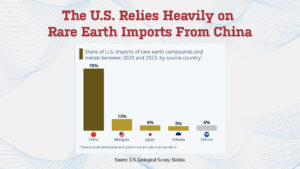
But, here’s the catch, we rely heavily on China for rare earth imports—the entire world does in fact. China has 70% of the world’s rare earth mining and has a stranglehold on 90% of rare earth refining capacity. From 2020 to 2023, China accounted for 70 percent of U.S. rare earth imports, with Malaysia, Japan and Estonia filling in the rest.
Take yttrium as an example, the mineral that we mentioned is key to producing the solar panels that are supposedly going to power us into the future. According to the U.S. Geological Survey, the U.S. is 100 percent import reliant when it comes to this mineral. 93 percent of what the U.S. imported came from China during that 2020 to 2023 period. That’s pretty much a monopoly.
As we said, yttrium is just one example. According to TD Economics, “In 2022, the United States designated fifty minerals as critical to the U.S. economy and national security as experiences with supply chain disruptions during the pandemic elucidated the potential for future trade vulnerabilities. For most of these minerals, the U.S. has minimal domestic deposits or refining capacity and as such is largely dependent on its trading partners to procure the supplies that it needs. China dominates global refining capacity for over half of the critical minerals listed, which creates a challenge for the U.S. amid rising trade tensions between the two nations.”
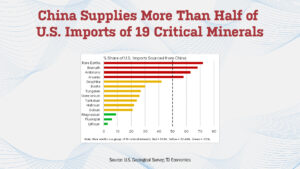
In fact, China supplies more than half of U.S. imports for 19 different critical minerals. The drive toward renewable energy will simply be passing the energy yoke around Americans’ necks from dependence on Middle Eastern oil to dependence on Chinese rare earth minerals. And, that is why we need to embrace the domestic, traditional energy sources like natural gas and oil that have led us to the 40-year low in energy imports.
ARC-ES is National Security
Passing Affordable, Reliable and Clean Energy Security (ARC-ES) legislation, not just in state legislatures, but at the federal level as well is the key to codifying the policies we need to continue our successful domestic energy production. This is literally a matter of national security. We have invested American time, resources and hard work into accomplishing something that people only a couple decades ago would have thought laughable. We have made America energy independent, energy secure and free of reliance on our enemies for oil and natural gas. We cannot go backward.
China has shown a willingness to leverage its near monopoly on certain mineral resources necessary for so-called “green” energy and electric vehicle production for some time. In 2010, they restricted exports to Japan. And, today, they have already restricted exports of certain minerals to the U.S. in retaliation for some of President Trump’s trade policies. We cannot once again make ourselves victim to nefarious foreign governments that only aim to harm American interests and security. ARC-ES legislation will guarantee that we prioritize our domestic energy sources to meet our own energy needs. We can once and for all have affordable, reliable and clean energy security completely fueled by our own American resources.