Net Zero 2050: A Colossal Train Wreck
Wright says the quiet part out loud
Recently, Energy Secretary Chris Wright addressed the topic of “net zero” goals, and he said the quiet part quite loudly. As Wright put it, “Net zero 2050 is just a colossal train wreck … It’s just a monstrous human impoverishment program and of course there is no way it is going to happen.”
TEA couldn’t agree more. We’ve been dispelling these false promises for years. And, that’s the real kicker—this isn’t news. The fact is that it’s not just naysayers like us and Secretary Wright that know. The same people that push these false promises know quite starkly—net zero is never going to happen.
Sounds kind of far-fetched, doesn’t it?
Net zero. It’s a term we’ve all heard for years. It’s also one of those terms that we’ve all heard sold as if it’s simply the way and not anything open to discourse. And, for the most part, many everyday Americans have forgotten what it means, if they ever even knew.
Some call it a promise. Some call it a pledge. Some call it a plan. We hear these “plans” from governments and from corporations. But, let’s roll back to the Net Zero 101 of it all and drill down to what this actually means.
The United Nations says, “Put simply, net zero means cutting carbon emissions to a small amount of residual emissions that can be absorbed and durably stored by nature and other carbon dioxide removal measures, leaving zero in the atmosphere.”
So, it’s a break-even scheme. We aren’t talking about eliminating emissions. We’re talking about cutting them to the point that nature can absorb the output, or that some sort of technology like carbon capture can balance the scales. According to the Fraser Institute, “’Net,’ the zero qualifier, is a hedge that considers the possibility of continued reliance on some fossil inputs whose emissions would be captured from the atmosphere and sequestered, resulting in no additions of anthropogenic CO2.” Got that?
The people building it, don’t believe in it.
According to a March 2025 survey from Bain and Company, 44% of executives from industries like oil and gas, utilities, chemicals, mining, and agribusiness now predict that the world will not meet net-zero emissions until 2070 or later. That is a considerable shift in opinion from only a couple years ago.
Grant Dougans, partner at Bain and Co.: “The amount of renewables required to get to any of those targets, back into the transmission required, and all the executional considerations, it’s just an extraordinary infrastructure request … These folks have a really good view of what it actually takes, because they’re the ones building it.”
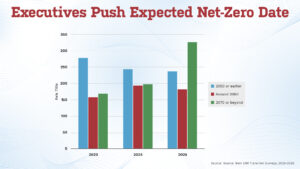
The survey shows “humanity has signaled demand both for the rapid development of low-carbon resources but also for the continued production of legacy energy sources.” As a result, executives with the very companies that would drive the changes needed to meet net zero goals have shifted their predictions for how long it will take. In 2024, only 32% of these leaders thought it would take until 2070 or later. And, in 2023, nearly half the executives were still predicting net zero could be hit by 2050.
According to Bain, “Despite record-breaking global investments in clean energy last year, the leaders of the companies tasked with delivering on the transition have become less optimistic about when the world will achieve net-zero carbon emissions.”
Actions speak louder than net-zero pledges.
And, just maybe that lack of optimism stems how comically and obviously empty the promises are from the world’s biggest polluter. According to energy author Robert Bryce, “there’s a China-size gap between these decarbonization pledges and the ever-increasing global demand for hydrocarbons.”
The International Energy Agency’s (IEA) Global Energy Review for 2025 showed that “soaring coal use and electricity demand in China (population: 1.4 billion) and India (population: 1.4 billion) is swamping all the climate policies and decarbonization efforts in the US, Canada, Europe, Japan, and South Korea.”
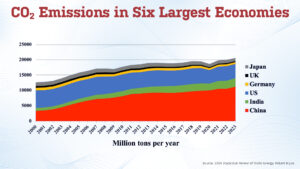
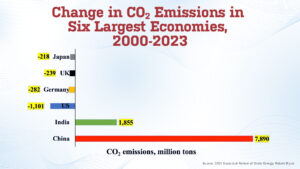
The IEA reports that in 2024 China’s coal demand increased by 1.2% to a new record high and that 60% of China’s electricity came from coal. China “now consumes nearly 40% more coal than the rest of the world combined, largely for power generation. Over one-third of all the coal consumed globally is burned by power plants in China. China’s influence in global coal market trends is unparalleled by any country for any type of fuel, with China’s share of global coal consumption now standing at 58%.”
Bryce: “When China finishes the 204,000 megawatts of coal capacity now under construction, it will have nearly 1.4 million megawatts of installed coal-fired capacity. Thus, within the next few years, China’s fleet of coal plants will be larger than all of the generation capacity — including coal, gas, nuclear, solar, wind, oil, biomass, and hydro — in the US.” (As Bryce notes, the U.S. has halved its coal consumption since 2010.)
We don’t agree with the Sierra Club on much, but they put it quite succinctly, “When countries promise that they can reach net zero without making sharp cuts to emissions in the next decade, those claims should not be taken at face value.” Oh, by the way, China says they’ll hit net zero before 2060. Do we believe them?
Can everyone chip in $9,000?
So, when the U.S. government and businesses makes net zero promises, it’s a lot like splitting the check at a restaurant with that frenemy that always order the most expensive thing on the menu. No matter how you cut it, American taxpayers are footing the bill for China’s expensive energy appetite.
According to a report from the Fraser Institute, “To achieve net-zero carbon, affluent countries will incur costs of at least 20 percent of their annual GDP … To eliminate carbon emissions by 2050, governments face unprecedented technical, economic and political challenges, making rapid and inexpensive transition impossible.”
BloomberNEF says net zero by 2050 will cost $200 trillion—or nearly $7 trillion a year. Goldman Sachs says that net zero by 2070 will cost $75 trillion—double the U.S. annual GDP. That’s a cost of approximately $9,200 for each and every human being on the planet.
And, that is a lot of money for most everyday people—especially when 68% of Americans say they wouldn’t even pay $10 more a month in the electric bills to battle climate change. All for a promise that absolutely no one intends to keep. We’ve already made great strides in the U.S. toward lowering emissions and cleaning our environment, and it is still important to maintain that momentum. But, that’s why TEA believes in affordable, reliable and clean energy security. It’s a full package. We can’t sacrifice energy that keeps us safe, healthy and financially sound at the altar of empty green promises like net zero.