
From Blocking Progress to Build, Baby, Build
October 6, 2025
After years of going backward, the new “Build, Baby, Build” strategy is finally taking hold. That’s right. Pipelines are making a comeback.
And, it’s about time. Pipelines create thousands of jobs. They bring lower and more consistent energy prices for households and businesses. They bring reliability in regions of the U.S. with some of our coldest and most volatile winters.
For far too long, this extremely necessary infrastructure has been under attack, and it’s taken its toll. According to U.S. Energy Information data, completed pipelines that move petroleum liquids have declined exponentially since peaking in 2014. In the recent years, only a handful of projects have been completed each year.

In recent years, huge projects—the Atlantic Coast Pipeline, Mountain Valley pipeline, Keystone XL, just to name a few—have been cancelled. These projects had been planned and invested in for years but were cancelled due to bureaucratic blockades from state and local governments, costly legal battles from extreme green groups and outright hostility from the former Biden Administration.
Canceled in 2020, the Atlantic Coast Pipeline would have carried much-need natural gas to households, businesses and national defense installations in Virginia and North Carolina. The pipeline would have saved consumers $377 million on their electric bills annually and invested $2.7 billion in economic activity into the region. When former President Biden revoked the Keystone XL oil pipeline permit on his first day in office, he effectively killed 60,000 jobs and nearly $10 billion in positive economic impact. Those are real losses that drive up costs and limit opportunities for everyday Americans.
There’s always a trade-off
The truth is there are millions of miles of pipeline stretching across the U.S. delivering fuel to individual and businesses consumers right now. They are the “arteries of the Nation’s energy infrastructure” and the proven safest way to transport energy products. Pipelines fuel our nation and they have for years. But maintaining and investing in such a necessary and valuable infrastructure is just as important as caring for our own bodies with necessary and preventative healthcare.
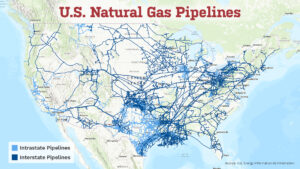
According to the U.S. Department of Transportation: “The nation’s more than 2.6 million miles of pipelines safely deliver trillions of cubic feet of natural gas and hundreds of billions of ton/miles of liquid petroleum products each year. They are essential: the volumes of energy products they move are well beyond the capacity of other forms of transportation. It would take a constant line of tanker trucks, about 750 per day, loading up and moving out every two minutes, 24 hours a day, seven days a week, to move the volume of even a modest pipeline. The railroad-equivalent of this single pipeline would be a train of 225, 28,000 gallon tank cars.”
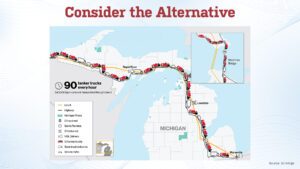
That’s the trade off the extreme anti-energy crowd never wants to talk about. If not pipelines, than what? Take Line 5 in Michigan. Each day Line 5 can “safely move up to 540,000 barrels of light crude oil, light synthetic crude oil and NGL [natural gas liquids].” To move the same amount of energy by tanker truck would require 2,100 trucks to drive the entire state of Michigan every day. Enbridge, the operator of the pipeline, estimates that that about 90 trucks leaving one of their terminals every hour. The entire reason Line 5 was built way back in 1953 was to minimize oil-carrying tanker traffic on the Great Lakes. Pipelines like these are progress not threats.
Never, never, never give up
But, there’s hope. Projects are springing up all over the country with the support of an administration with bold, common-sense energy policies in Washington, as well as tacit support from some regional leaders that were blocking infrastructure projects just a few years ago.
In the Northeast, the Constitution Pipeline has found surprising bipartisan support—after years of green-at-any-cost leaders in the region blocking the necessary infrastructure to bring affordable natural gas to New England families. As a result, the region has paid astronomical prices for home heating and even relied on imported natural gas from Russia. The proposed 125-mile pipeline from Pennsylvania’s Marcellus Shale to upstate New York aims to boost natural gas supply to Connecticut and, by extension, Massachusetts, Rhode Island, and New Hampshire. If approvals go through, construction could begin in late 2026, with the target in service near the third quarter of 2027.
The embattled Line 5 in the Great Lakes region was recently bolstered by support from the Trump Administration in a federal lawsuit against Michigan Governor Gretchen Whitmer’s attempts to block the extremely necessary pipeline. According to the Mackinac Center, “The Line 5 pipeline, operational since 1953, transports 540,000 barrels per day of light crude oil and natural gas liquids, supplying 55% of Michigan’s propane, 65% of Upper Peninsula propane, 45% of refinery feedstocks in Michigan, Ohio, Pennsylvania, Ontario, and Quebec, and jet fuel for airports like Detroit Metropolitan Wayne County and Toronto’s Pearson.” 315,000 households, especially in Michigan’s Upper Peninsula, rely on propane for home-heating. A Consumer Energy Alliance study said a shutdown of Line 5 would result in a loss of 33,755 jobs, $20.8 billion in economic activity and $2.36 billion in salaries, wages and benefits in the four-state region of Michigan, Ohio, Indiana and Pennsylvania.
The Alaska Liquefied Natural Gas (LNG) Project has seen momentum since the Trump Administration has put it at the forefront of its American energy dominance goals. The project would include a pipeline and LNG terminal that would allow us to more easily export natural gas to American allies in the Pacific, lessening their dependence on Russian gas. Construction of the Alaska LNG Project would create over 10,000 jobs and its pipeline would have the capacity to move 3.3 billion cubic feet of natural gas a day.
There should be a law.
But, hope is a fragile thing without action. We must keep moving forward. If future leaders take us back to the dark days of blocking energy infrastructure projects just to please the green-at-any-cost disciples, we may do irreparable damage to this system that literally fuels our country—and our economy and our wallets will be where the hit really hurts. That’s why TEA supports a federal law that codifies Affordable, Reliable and Clean Energy Security (ARC ES).