
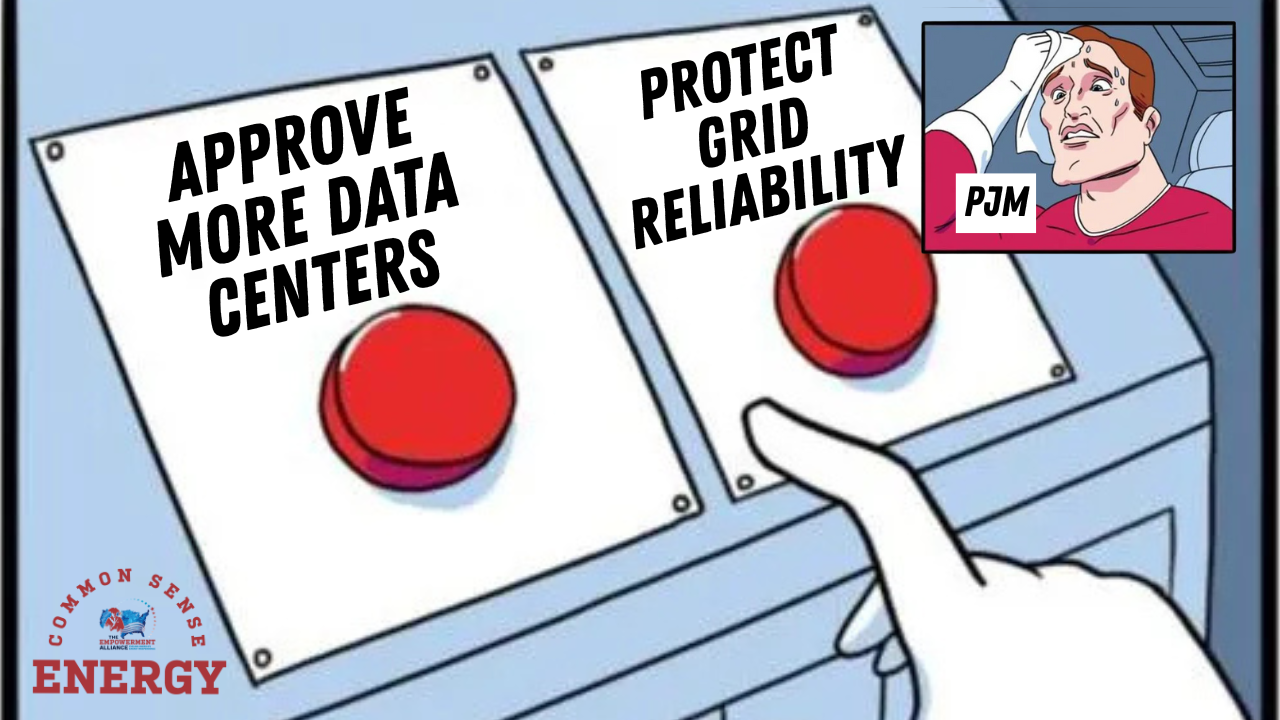
Data Centers In Exchange For Blackouts? No Deal
December 5, 2025
Need to know
- Check out TEA’s website for the latest in energy news and opinion.
- Afternoon TEA: What we’re thankful for at TEA.
- TEA Takes: Energy dominance and Balderson’s ARC go hand-in-glove.
- One green group’s legal mess has other nonprofits worried.
- Data centers powering the AI boom are pitting states against each other.
- Lawmakers across parties eyeing tax credits to lower Mainers’ energy bills.
- Pa. residents brace for rising electricity bills.
- Litigators build a toolkit to fight AI data centers.
- Trump strikes “renewable” from Colorado energy lab name.
- Canada’s PM Carney rolls back climate rules to boost investments.
- Ohio lawmaker seeks to codify Trump’s energy policies
- Europe energy commissioner: Russian oil and gas done for good.
Common sense
DATA CENTER DILEMMA: The PJM Interconnection’s market monitor urged the Federal Energy Regulatory Commission to rule that large data centers can only come online if the grid operator can still meet reliability metrics.
We agree with the concept of no more PJM data centers unless they can be reliably served. Grid operators have a duty to provide affordable, reliable energy, and they cannot continue to add data center loads without adequate generation to serve them.
Why it matters: It is clear that energy affordability and reliability have become this decade’s “kitchen-table issue,” as the RealClearEnergy piece points out. PJM’s 65 million customers across 13 Midwest and Mid-Atlantic states and Washington, D.C., are reliant on a dependable grid.
Affordable energy reduces the cost of living. Reliable energy promotes economic growth and innovation. Clean energy protects our environment and sets an example for the world to follow.
Consider:
- PJM is considering proposing to allow data center loads that it cannot serve reliably and that will require periodic blackouts for data centers and other customers, Monitoring Analytics, the grid operator’s market monitor, said.
- “That result is not consistent with the basic responsibility of PJM to maintain a reliable grid, and is therefore not just and reasonable.”
- Large data center load additions in PJM have been driving up transmission costs as well as energy and capacity prices.
- PJM’s board plans to develop a significant load interconnection proposal and file it for approval by FERC.
Required blackouts are an absolute non-starter. Obviously, ARC Energy Security legislation would prevent this from happening. Reliability is a cornerstone of this legislation.
“PJM markets face an urgent need for immediate clarification of PJM’s authority over the interconnection of large new data center loads,” the market monitor said.
Obviously, this issue needs to be resolved quickly, not after months of bureaucracy and scores of hearings. Lives and livelihoods are on the line.
Bottom line: The primary responsibility of a grid operator is to keep the lights on. PJM cannot continue to approve data centers if it jeopardizes reliable energy for the rest of their customers.
Nonsense
‘BIG GREEN GOOF’: Dem-leaning group roasts New York’s green energy law as an ‘undeniable’ failure as customers zapped by soaring costs. This is a leftwing think tank, the Progressive Policy Institute, that found fault, much fault, with the 2019 Climate Leadership and Community Act.
Why it matters: Replacing natural gas with less predictable options like solar and wind has been a struggle — and the grid has grown less reliable as demand for energy surges and the state’s aging utility infrastructure is increasingly taxed.
Electricity prices are 44% higher than the national average, and residential rates have risen 36% since 2019, nearly three times faster than the rest of the country.
Consider:
- The law was supposed to start in January for new buildings up to seven stories, and then for all other buildings in 2029.
- A top aide to Gov. Kathy Hochul said she has slowed down implementation because of cost concerns.
- New York is behind on nearly every central climate mandate. Only solar power is on track.
- Fossil fuels still supply nearly half of New York’s electricity.
The “premature” closure of the Indian Point nuclear power plant in Westchester — a major supplier of zero-emissions energy to the Big Apple — slowed the state’s progress toward clean energy.
Upstate Rep. Elise Stefanik, a Republican looking to unseat Hochul as governor, pounced quickly. “Kathy Hochul and single-party Democrat rule have caused the affordability crisis with New York families paying the highest energy and utility prices in the nation,” she told The New York Post.
Justin Wilcox, executive director of the pro-business, taxpayers group Upstate United, said, “The findings in PPI’s report underscore a hard truth: New York’s current climate strategy isn’t delivering for families, businesses or the grid.”
Bottom line: When even the left wing groups are criticizing green-at-all-cost policies, you know they’ve gone to far. A federal solution like the Affordable, Reliable, Clean Energy Security Act would deliver affordability nationwide.
A look ahead
Hearing On Environmental NGO Abuses: On Wednesday, December 10, the House Natural Resources Subcommittee on Oversight and Investigations will have an oversight hearing on “Abuse of the Equal Access to Justice Act by Environmental NGOs.”
Quote of the week
“Energy isn’t just one industry — it’s the foundation of EVERY industry. Lower energy costs are felt through the entire economy, and that’s why we’re putting affordability at the center of the American Energy Dominance Agenda!”