
No End To “Green” Tax Season
April 20, 2026
This week, those of us at TEA are breathing a sigh of relief along with most Americans. Tax Day
is over for another year. Now, we can enjoy spring without deciphering confusing forms and
worrying about IRS deadlines.
Except there’s some bad news. When it comes to energy and the way our government has
historically picked winners and losers with subsidies and mandates, most American households
and businesses pay hidden energy “taxes” year-round.
These evergreen taxes don’t just show up in your energy bills, either. Since, energy literally
fuels every aspect of our lives, when it becomes unaffordable, that drives up the cost of
everything else. When gasoline prices go up, so does the cost of transporting groceries, home
goods and all the other things we buy at the corner store. When the cost of electricity goes up,
so does the cost of construction, manufacturing and every other business. Many energy sources
are even components in the very products we buy—petrochemicals derived from oil and
natural gas are ingredients in over 6,000 everyday products and high-tech devices.
The newest green scheme—decoupling
We usually end up telling you about subsidies for so-called “green” energy sources. (We’ll get
to those below.) But, the Energy Bad Boys blog recently revealed yet another way that
artificially propping up energy sources like wind, solar and batteries is taxing Americans’
budgets every time they pay their electricity bill. There’s a practice called “decoupling” which
some state and local governments have created to protect utilities’ revenue if they lose money
because of—get this—those energy efficiency programs that everyone including your utilities
tell you will save you money. Guess who pays to protect the utilities’ bottom line? That’s right,
you.
As the Energy Bad Boys put it: “Under decoupling, utilities are guaranteed their authorized
revenue requirement regardless of actual sales volume, breaking the historic link between
revenue and volumetric sales. If sales fall below projections, rates are adjusted upward through
periodic true-ups; if sales exceed projections, rates are adjusted downward. The utility’s
revenue is decoupled from the volume of electricity sold.”
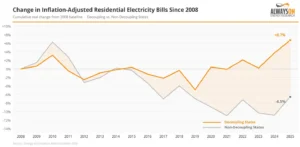
Energy Bad Boys: “Residents in the 19 jurisdictions with full decoupling mechanisms in place
decreased the average customer monthly electricity usage by 7.7 percent since 2008, while
their bills have increased by 60 percent. Essentially, residential customers are paying more for
less electricity. While the same trend is true for the rest of the country, these 19 decoupling
jurisdictions show it much more pronounced, as they decreased monthly usage by 94 percent
more than all other states in the U.S. since 2008, yet bills increased by 50 percent more. In
other words, these jurisdictions saw greater electricity conservation than other states, yet bills
still increased by a larger percentage.” Conning American households into paying more for
using less actually makes even less sense that tax code.
Forcing “green” investments…
And, then there’s the ways that Americans have been paying hidden energy “taxes” for
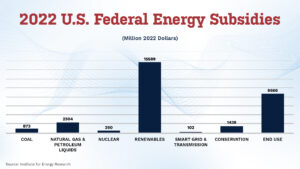
decades. According to the Institute for Energy Research, “Federal subsidies to support
renewable energy formed nearly half of all federal energy-related support between fiscal years
2016 and 2022. Traditional fuels (coal, natural gas, oil and nuclear) received just 15 percent of
all subsidies between FY 2016 and FY 2022, while renewables, conservation and end use
received a whopping 85 percent. Renewable subsidies more than doubled between FY 2016
and FY 2022, increasing to $15.6 billion in fiscal year 2022 from $7.4 billion in fiscal year 2016
(both in 2022 dollars). Federal subsidies and incentives to support renewable energy in fiscal
year 2022 were almost 5 times higher than those for fossil energy, which totaled $3.2 billion in
subsidies.”
But American taxpayers aren’t getting a return on their investment. Wind and solar energies
are only provide 14% of the electricity produced in the U.S. In contrast, nuclear power receives
only a fraction of the handouts, but contributes 18.6 % of the electricity produced in the U.S.
Traditional hydrocarbon sources also receive much less taxpayer support while producing a
60% majority of our nation’s power.
…Providing zero return
But, all those tax breaks (that come out of the pockets of American taxpayers) for wind and
solar energy over the last decade should have resulted in savings on our energy bills, right? Not
so much.
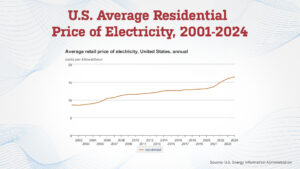
According to the Energy Information Administration, the retail price of electricity in the United
States has risen at a consistent pace over the last two decades. In 2001, Americans were paying
an average 8.58 cents per kilowatt hour for residential electricity. In 2024, that price was 16.48
cents per kilowatt hour, nearly doubling in just over 20 years. And, the biggest uptick on the
graph can be seen starting in 2021—just before the Inflation Reduction Act became law. From
2021 to 2024, there was a 21% percent increase in the average price American families paid for
electricity, and that happened during the exact same period that Biden’s IRA green energy slush
fund went into place.
ARC will end the endless tax season
No one likes Tax Season, but at least we know it’s coming…and when it’s over, thank goodness.
When it comes to government energy subsidies, mandates and now decoupling—essentially a
bailout for utilities investing in renewable energy—the taxing is secret, endless and deceitful.
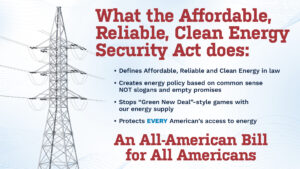
That’s why we need common-sense laws like the Affordable, Reliable, Clean Energy Security Act
that will shine a light on energy policy and practices to ensure that Americans are getting the
most affordable energy possible, while ensuring reliability and protecting the environment.
Rather than the government blocking productivity and driving up costs by picking winners and
losers, this bill will set fair and sensible rules under which the best energy options for American
families and businesses win. And, American families will no longer face a Tax Day every single
month when they open their electricity bill.