

And Now, Time For A Factcheck
July 11, 2026
You’ve probably seen some news recently about an annual report on energy around the globe.
This report with its mouthful title, the Statistical Review of World Energy, has been put out
since the 1950s—previously by BP and now by the Energy Institute. It covers all manner of
global energy statistics. (It’s free at that link, if you want to download your own copy.)
The report usually inspires a flurry of headlines and opinion pieces based on its findings. So, this
week TEA is going to take a look at some of the most interesting findings and check the facts on
some of the top headlines from the report…

The world is growing—that’s a good thing
Unsurprisingly, global demand for energy grew since the last report. Specifically, according to
the Review, “total energy supply (TES) exceeded 600EJ in 2025, a rise of 1.7% over 2024,
continuing the long-term upward trend in energy demand.” Now, there are some in the
doomsday crowd that actually want you to believe this is a bad thing. Don’t listen to them.
There is a reason that the growing need for energy is a “long-term upward trend” and that’s
simply because the world becomes a bigger and better place each year. We continue to make
more advances that improve life for everyone across the globe. Here’s just a few of the cool
things the human race did last year. And, we need energy to fuel that growth.
Going backwards is not a solution, it’s a scare tactic. We never want to see that total energy
supply number go down. If we do, it’s not a victory. It’s because something bad has happened
and people are worse off for it.
Fossil fuels lead…because they work
One thing you’ll see with the analysis of this data is a lot of people playing the percentage
game. By that we mean, writers and pundits will latch on to a change in percentage and just
leave out what the real hard numbers tell you. The most prime example this year are the
headlines declaring that renewable energy sources showed the largest growth in energy supply
ever. But, wait, because there’s some questionable math under those headlines. First, that
statistic combines all manner of “renewables” into one category. If you were to combine all the
traditional energy sources in the same way—like fossil fuels and nuclear—in the chart below,
renewables get left in the dust.
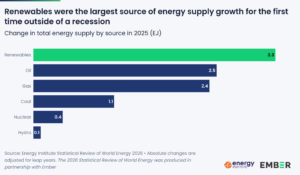
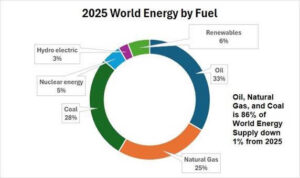
Second, that number is a percentage of the growth, not the totals. If you look at the hard totals
in the chart below, “Fossil fuels continued to expand in absolute terms and retained their
dominant position, accounting for 86% of TES.” So before the green-at-any-cost crowd
celebrates their big percentage-of-the-growth, fuzzy number win, we’d love to hear how
they’re going to keep the world’s lights on when they supply less than 10 percent of the world’s
power.
China: Still the King of Pollutin’
And speaking of the percentage game, you may have seen one of the most shocking headlines
of all telling you that the United States’ emissions grew (gasp) four times more than China’s.
Well, that seems shocking…until you look at the real numbers.
According to IIR Energy: “In raw numbers, China’s CO2 emissions from energy totaled
approximately 11.2 billion tonnes last year, far outstripping emissions from the U.S. (4.8 billion
tonnes), India (3 billion tonnes) and Russia (1.6 billion tonnes). Global carbon emissions from
energy last year reached roughly 35,806 million tonnes.” So before we suddenly start patting
China on the back for being the newest Climate Warriors, we should remember that they had
more emissions than the U.S., India and Russia combined in 2025.
Another green feather you may have seen being placed in China’s proverbial hat is that they
installed more wind and solar capacity than any other country in 2025. And, it’s true, they did.
But, let’s talk about how China does wind and solar.
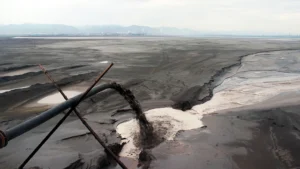
As we’ve mentioned many times here, China has a near monopoly of the supply and processing
of rare earth minerals that are necessary for renewable energy, battery and electric vehicle
technologies. The way China mines those rare earth metals that are necessary for their big
“green” transition is not a pretty sight. China’s rare earth operations have “poisoned water and
soil have caused abnormal disease rates in ‘cancer villages’ from which impoverished residents
cannot afford to move.”
And, then there’s the small matter of China’s slave labor. Xinjiang, a region of China that is
home to the oppressed Uyghur minority, produces half the global supply of polysilicon, a metal
critical for constructing solar panels. In 2021, the New York Times reported: “Up to a million or
more minorities may have been detained in indoctrination camps and other sites where they
are forced to renounce religious bonds, and risk torture, assault and psychological trauma.” The
AFL-CIO even asked the Biden administration to block imports of products containing
polysilicon from Xinjiang due to the potential use of forced labor. Then-AFL-CIO President
Richard Trumka: “The region’s outsized role in the global solar energy product supply chain and
convincing evidence of systematic forced labor in the Uyghur region’s solar production
demands immediate focused action.” Hard to call it a green victory when it was won with
pollution, disease and slave labor.
Just the facts, TEAm, just the facts
At TEA, we love facts. But, we also know that in a world where we are flooded with information
all day, every day, it’s very easy for facts to get distorted and opinions to be blurred with the
truth. Tools like the Statistical Review provide a lot of valuable insights (we’ve been citing them
for years!) but we all need to be vigilant before we just accept a headline or an opinion piece at
face value.
Too often, statistics are used to scare you and push you toward and agenda that doesn’t work
for everyday Americans. We’re committed to digging below the surface to show you the truth
behind the numbers. And, we’re committed to embracing real-world, commonsense solutions
like Affordable, Reliable, Clean Energy Security (ARC-ES) that balance a cleaner environment
with dependable and low-cost energy. The facts show we can absolutely do both.