
An LNG victory to celebrate the New Year!
January 12, 2026
Happy New Year from all of us at TEA! We look forward to another year of victories for
Affordable, Reliable and Clean Energy Security (ARC ES) for American families. In fact, the
United States started off 2026 with a huge victory—fueled by increased domestic energy
production—that you may not have heard about. In 2025, we became the first country to
export more than 100 million metric tons (mmt) of liquefied natural gas in a single year!
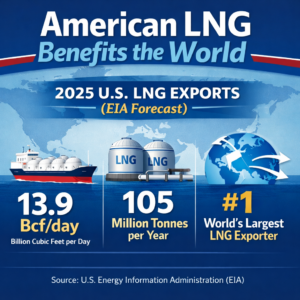
This accomplishment was primarily because of start-up production from new LNG plants in the
U.S. Not only was this a new annual record, but throughout the year, we also set five monthly
production records—showing the benefits of consistent, common-sense investment in
domestic production.
As Jason Feer, head of business intelligence at shipping firm Poten and Partners put it, “It is
remarkable that in nine years the U.S. has gone from zero LNG exports to over 100 mmt, and
the success validates the U.S. approach … and the reliability of U.S. supplies.” Much of these
U.S. exports went to our allies in Europe, but also the Middle East and Asia, which directly
reduced reliance on natural gas purchase from Russia.
The U.S. is a “natural gas superpower.”
And, when America is the key producer of energy for our own needs and globally, that makes us
and the world safer and cleaner. U.S. LNG is the literal light on the world’s horizon, and our
ability to supply the world with natural gas is only growing.
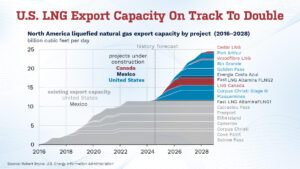
According to the U.S. Energy Information Administration, U.S. LNG export capacity will likely
increase from 11.5 billion cubic feet per day in 2023 to 24.4. in 2028—more than doubling in five years. According to energy author Robert Bryce: “If that happens, US LNG export capacity
will equal or exceed, the gas production of both Iran and China. (In 2023, Iran produced 24.3
Bcf/d, and China produced 22.7 Bcf/d). That, ladies and gentlemen, is evidence that the US is a
natural gas superpower.”
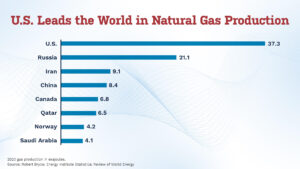
Our ability to supply the world with natural gas has become possible because the U.S. leads the
world in natural gas production. U.S. natural gas production plateaued sometime in the 1970s.
But, in 2005, it started to grow again significantly. That achievement was been driven by
groundbreaking technological advances like hydraulic fracturing that have allowed us to tap
America’s extensive natural resources. Since then U.S. natural gas production has more than
doubled. According to Bryce’s analysis of data, the U.S. is now producing more natural gas than
Canada, China, Iran, Norway and Qatar combined.
Oh, and, it’s good for the environment.
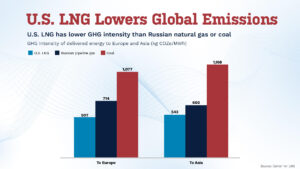
According to data from the Center for LNG, switching to natural gas to generate electricity is
the top reason the U.S. has been so successful at lowering emissions since 2005. That same
principle can be applied abroad. U.S. LNG nearly halves the emissions from the use of coal in
Europe and Asia. In a head-to-head comparison, natural gas exported from the U.S. even has
significantly lower emissions than natural gas from Russia.
Let’s keep the ARC ES ball rolling.
This achievement is only possible because of leaders making policies that nurtured growth,
technology and economic investment. On his first day back in office, President Trump removed
the Biden “pause” on LNG export approvals. And, new energy secretary, Chris Wright, made
five LNG-related approvals between taking the job in February 2025 and mid-March 2025.
As Secretary Wright put it at CERAWeek 2025: “I'm honored to play a role in reversing what I
believe has been very poor direction in energy policy. The previous administration's policy was
focused myopically on climate change with people as simply collateral damage. My predecessor
was on this stage one year ago saying that LNG exports would soon be in the rearview mirror.
Think about that for a moment. Natural gas today supplies 25% of global primary energy and
has been the fastest growing source of energy over the last 15 years.”
Those are the facts. Natural gas is the most affordable, reliable and clean energy source in our
energy mix. But, we must be vigilant—and that’s why we need an ARC ES law at the federal
level and more state’s to embrace the policy as we’ve seen in Ohio, Tennessee and Louisiana.
We must continue to fight for common-sense energy policies that allow us to invest in
American energy production.
If we allow ourselves to be dragged backward by short-sighted leaders with a politicized green
agenda, we will sacrifice our standing as a world energy superpower to the countries that
follow on that list, like Russia, Iran and China. That isn’t good for the world and it certainly isn’t
good for America.