Back to school hits the gas
August 9, 2026
Since the kids out there are heading back to school soon, we thought we’d put our teaching hats on and revisit one of our favorite “Did you know…” lessons here at TEA.
Now, we tell you about the affordable, reliable, clean and energy security benefits of traditional American energy sources like natural gas, petroleum and nuclear power all the time. Things like:
- Households that use natural gas for heating, cooking and other appliances save an average $1,030 per year compared to homes using electricity for such appliances.
- Over 75% of U.S. electricity generation comes from traditional energy sources like natural gas, coal and nuclear. Nearly 41% comes from natural gas alone.
- The U.S. is the world leader in lowering carbon emissions, largely because of increased use of natural gas for electricity generation.
- In 2018, the U.S. surpassed Russia and Saudi Arabia to become the world’s top producer of natural gas AND oil largely because of the U.S. shale revolution.
And, don’t get us wrong, we believe energy is one of the most important issues to consider—in fact it underlies almost any other issue from the economy to health care to national security. But, energy sources like natural gas and petroleum are also a part of many, many other aspects of our lives that most people don’t even think about.
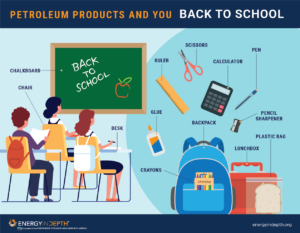
Take the “Back to School” shopping that many families around the country are doing right now. Many of the items in that shopping cart or your kid’s classrooms came from petroleum products. Pens, rulers, calculators, chalkboards, all from petroleum products. Even the backpack they carry it all in and the desk they sit at to learn, you guessed it, petroleum.

But, wait, there’s more
There are actually over 6,000 everyday products derived from oil and natural gas. According to the Department of Energy: “Major petrochemicals—including ethylene, propylene, acetylene, benzene, and toluene, as well as natural gas constituents like methane, propane, and ethane—are the feedstock chemicals for the production of many of the items we use and depend on every day. Modern life relies on the availability of these products that are made in the United States and across the globe.”
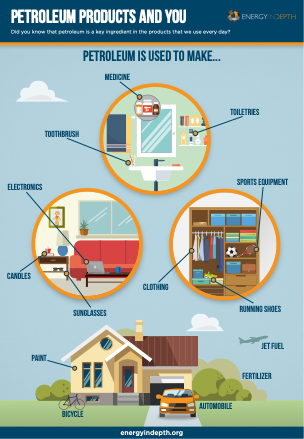
Here’s a few of the items in your house, you probably had no idea started with petroleum:
- Aspirin: “One of the most widely used medications in the world to relieve pain, inflammation, and fever. Its composition includes derivatives of benzene, a hydrocarbon obtained from petroleum.”
- Solar Panels: Yeah, that’s right. Solar panels are made from fossil fuels. “Fossil fuels are used in the manufacturing of solar panels but are also found in the solar cell parts that help convert sunlight into electrical energy.”
- Toothpaste: “Toothpaste uses poloxamer 407, a common petroleum derivative that helps oil-based ingredients to be dissolved in water.”
- Clothing: “Synthetic fabrics such as polyester, nylon, acrylic, and elastane are derived from petroleum and natural gas. They dominate the fashion industry because they offer durability and low cost.”
- Electronics: “Plastics and other petroleum-based products are used in electronics. From speakers and smartphones to computers, cameras, and televisions, most electronics have components derived from oil.”
The doctor recommends…oil and gas
And, we aren’t just using petroleum products at home and school. These products are also integral to highly important industries.
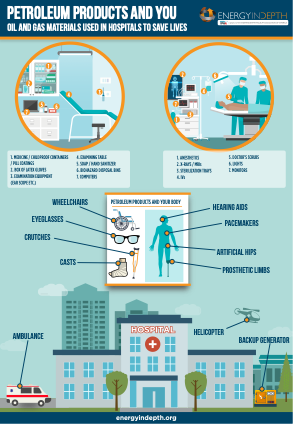
Like health care, for example. According to the U.S. Chamber of Commerce: “Natural gas and petroleum-based products are ubiquitous in hospital settings. Oil and natural gas provide Petroleum-and-You-Final petroleum_hospital_v5-1 the feedstock for advanced plastics which are used to make countless essential medical supplies. One estimate found that an average hospital emergency room has 90 products that are derived from petroleum and natural gas products. From respirators, gloves, and personal protective equipment (PPE) to sterilization trays, IV lines and ventilation tubes. … Without these energy-derived products, it is not hyperbole to say that it would be impossible—not just difficult, but impossible—to maintain the modern health care standards we too often take for granted.”
Or farming. An American Gas Association (AGA) analysis found:
- U.S. agriculture is one of the largest consumers of natural gas, consuming roughly 1.7 trillion cubic feet (“Tcf”) of natural gas – equivalent to almost 15% of all U.S. commercial and industrial consumption demand.
- Fertilizer and other agrochemical production is the most significant consumer of natural gas in the agriculture supply chain.
- Natural gas is required to produce nitrogen, a main fertilizer component, which enables increased crop yields.
- Between 70% and 80% of the energy used to produce critical fertilizers comes from natural gas.
As AGA President and CEO Karen Harbert puts it: “Natural gas and the nation’s natural gas infrastructure is essential for a thriving agriculture sector in the United States. There is a direct connection between the availability of low-cost natural gas and the cost of food on store shelves in every state across our nation. We cannot afford to drive up the cost of food for Americans at a time when they are already feeling the impacts of inflation broadly. Any attempt to ban or restrict access to natural gas would do just that—driving up prices for energy directly and other critical products like food without the environmental gain that many claim.”
ARC-ES: Not just for electric bills
This is why defending affordable, reliable and clean energy security (ARC-ES) is so important.
If green-at-any-cost politicians had their way, we’d leave all the fossil fuels in the ground. And, if that happens, besides the world coming to a grinding halt because there’s no power left, suddenly our medicine cabinets are empty, our refrigerators are bare and all the electronics in our house disappear.
Yes, for all the reasons we always talk about, the energy policy choices made by our leaders effect our everyday lives. We know this when we fill up at the pumps and when we pay our electric bills. But, even beyond that, it filters down to the smallest, most basic needs we take for granted every day.