

Good news for American energy dominance!
July 27, 2026
The thing is, when there’s bad news, you’ll likely hear about it in headline after headline. But, unfortunately, when good things happen, next to no one talks about it. Well, here at TEA, we want to talk about a couple of the good things that just happened in the energy world.
The U.S. had two huge accomplishments recently in the realm of energy dominance, and there’s a good chance you haven’t heard about either of them. But, even without hearing the news, you’ve probably felt the effects in your everyday life without even realizing it. And, really, that’s almost better. But, let us tell you what the headlines haven’t…

Most crude in history!
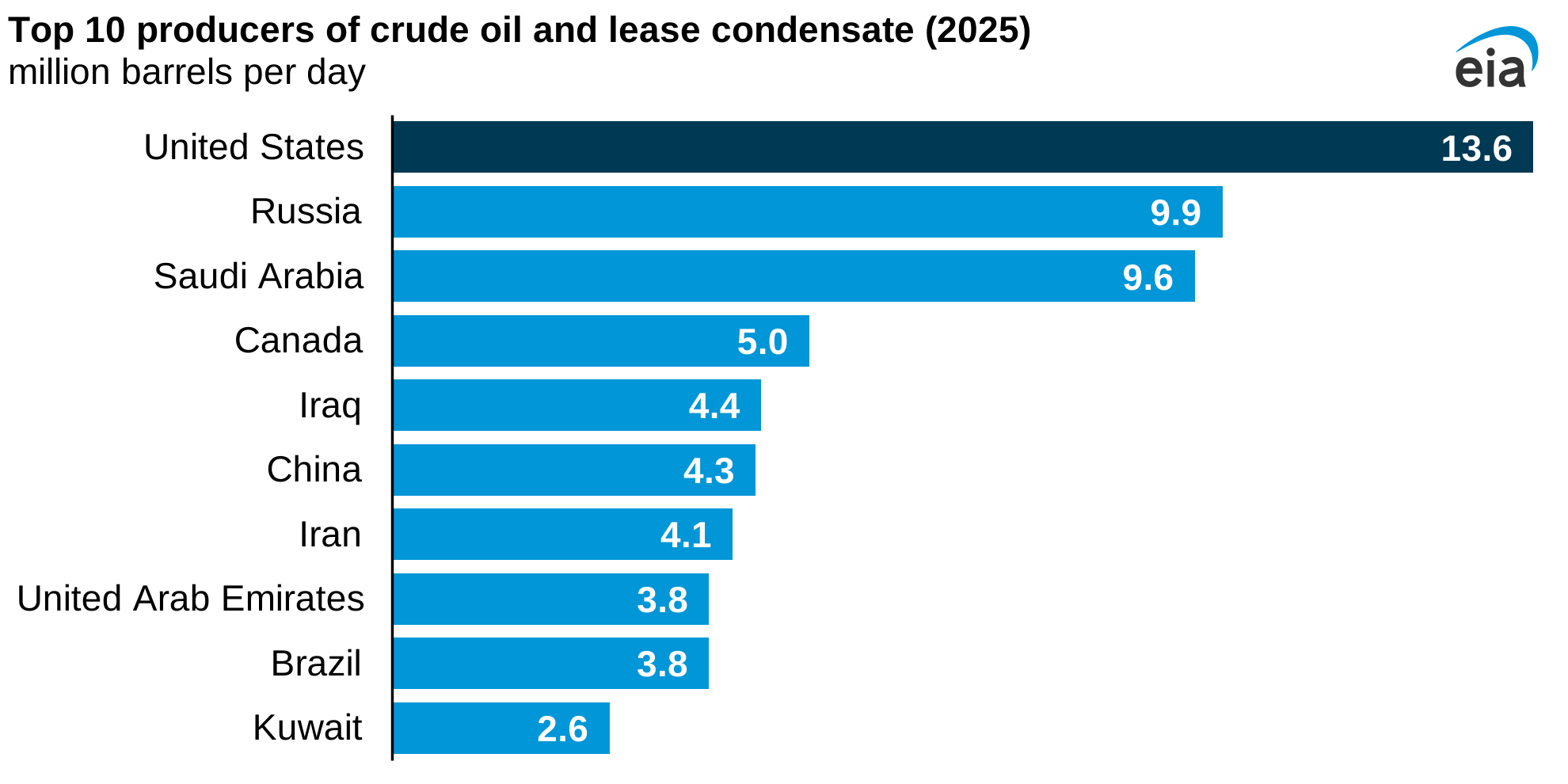
A couple of weeks ago, the U.S. Energy Information Administration (EIA) announced that not only did the U.S. produce more crude oil than any other country in 2025, but that we produced more crude than any other country in history!
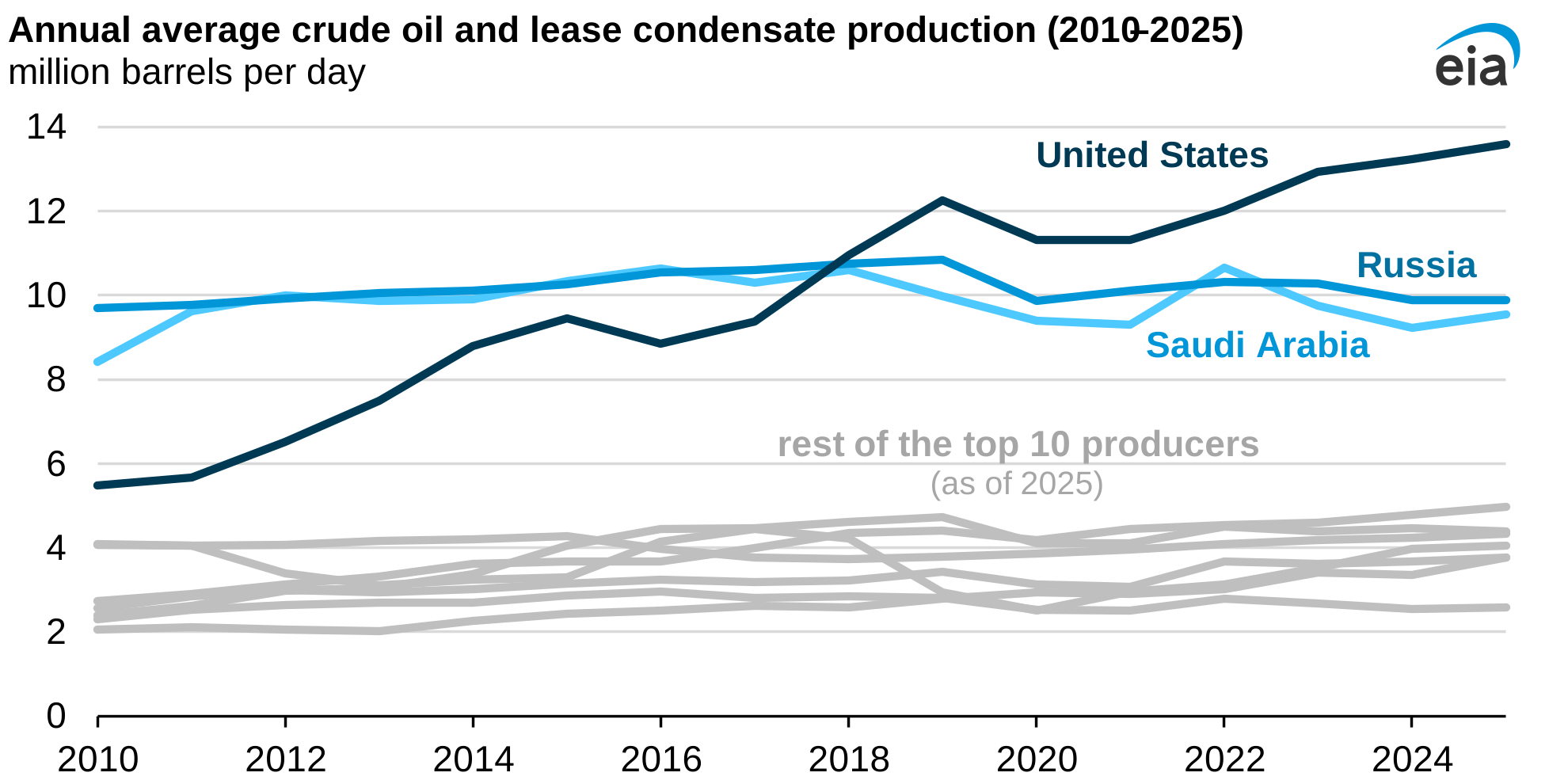
Here’s how the numbers break down: crude oil production in the United States averaged a record-high 13.6 million barrels per day (b/d) in 2025, breaking the previous U.S. and global production record of 13.2 million b/d set in 2024. U.S. crude oil production was about 40% higher on average in 2025 than that from the next two largest producers, Russia and Saudi Arabia.
In 2018, the U.S. surpassed Russia and Saudi Arabia to become the world’s top producer of natural gas AND oil largely because of the hard work and ingenuity of the American energy industry. Now, we produce more than enough energy to fuel America and her people with affordable, reliable and clean American-made energy. But, not only that, now we can also export energy to support our allies around the world—creating a safer world both at home and abroad.
Reliability = Security = Affordability
The EIA attributed this huge accomplishment to “continued gains in drilling productivity and operational efficiency across key shale basins, which allow operators to extract more oil per well.” According to Energy in Depth, “U.S. crude oil production increased by three percent, or 350,000 b/d in 2025 while operators ran five percent fewer rigs across the Lower 48, and drilled one percent fewer wells than in 2024.” This increased efficiency also contributes to lower prices. In fact, West Texas Intermediate crude fell from $77 per barrel in 2024 to $65 per barrel in 2025.
As Energy in Depth puts it: “The significant increase in domestic oil production can be expected to help energy affordability in the United States. U.S. production alone does not determine gasoline prices because oil trades in a global market and refining costs and regional market conditions also shape what drivers pay. Even so, abundant domestic production gives consumers an important layer of protection when overseas supplies are disrupted. That advantage can be seen amid renewed conflict involving Iran and the Strait of Hormuz, where threats to a major global oil route have pushed prices higher. As Energy in Depth recently explained, American producers can respond to tighter markets by bringing additional barrels forward, reducing the country’s exposure to sudden supply shocks. Robust domestic production equates to energy independence in times of crisis. EIA has likewise found that growing U.S. production has helped slow increases in oil and gasoline prices in recent years.”
In other words, efficiency and reliability lead to affordability and energy security. Just what we’ve been saying all along!
And, then there’s the gas
And, this victory for American oil production goes hand in hand with another victory for American natural gas. EIA: “Parallel to the growth in crude oil production, U.S. associated natural gas production has also surged, driven by activity in oil-dominant plays like the Permian. This abundance of associated gas has continued to support domestic natural gas-fired electricity generation and growing natural gas exports. In 2024, the most recent year data are available, the United States was the world’s largest natural gas producer.”
On top of that, a new report from S&P Global predicts that liquified natural gas (LNG) is expected to be the U.S.’s second-largest net export industry and surpass a one-third share of the global market within five years. Demand for American LNG is expected to double to 36 billion cubic feet per day (bcf/d), which is 25 percent higher than previous estimates.
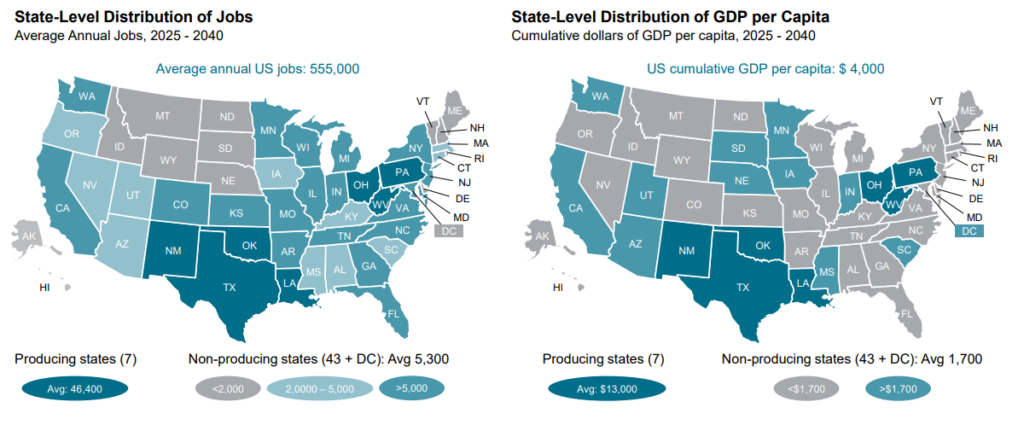
Not only is this great for U.S. energy dominance, but S&P Global says: “Growing exports of U.S. liquefied natural gas (LNG) are now on track to support 550,000 jobs annually and contribute $1.4 trillion to U.S. gross domestic product through 2040—exceeding previous expectations—while having a negligible impact on domestic gas prices.” Across the supply chain, this growth is expected to generate more than $2.9 trillion in business revenues, $206 billion in federal and state tax revenue, and nearly $630 billion in labor income. S&P even suggest that this will have economic impact far beyond just gas-producing states, with 42 percent of jobs and 33 percent of GDP impacts occur in non-gas-producing regions.
As Energy in Depth puts it, “The data proves that there is no trade-off between energy dominance and affordability and directly rebuts one of the most common arguments against expanding U.S. LNG exports – that growing exports come at the expense of American consumers. Instead, S&P concludes the United States can expand LNG exports while maintaining some of the lowest natural gas prices in the world.”
The ARC-ES formula works
These huge accomplishments are an amazing example of the principles behind TEA’s Affordable, Reliable and Clean Energy Security (ARC-ES) mission. These aren’t just standalone concepts. They all work together to secure the United States’ energy dominance while providing affordable and reliable energy for American consumers.
The current conflict with Iran is a prime example. While gasoline prices have risen, there have not been the crippling shortages we’ve seen historically with such conflicts. The dire consequences predicted at the beginning of the conflict haven’t come to pass. That is directly related to the U.S. and other nations ramping up production and filling the gap. As Grist put it, “The United States, Venezuela, and Norway all pumped out more crude in the first half of the year than they had in previous months, with those additional barrels going to countries that had previously relied on shipments from Iraq and Saudi Arabia. South Korea, for instance, doubled its oil imports from the United States between February and April of this year.”
ARC-ES isn’t just a catch phrase. It’s a design for all these principles—affordability, reliability, environmental stewardship and energy security—to work together to power America in the safest and most productive way possible. Finally, this design is being applied in the real world and the results are unquestionably good news.