

Pain At The Pump Needs A New Cure
March 22, 2026
We are once again experiencing a pain, we’ve become all too familiar with—rising gasoline
prices. Americans have unfortunately become used to a routine of prices at the pump
skyrocketing when events—from pandemics to wars—around the globe start effecting our
bottom line at home.
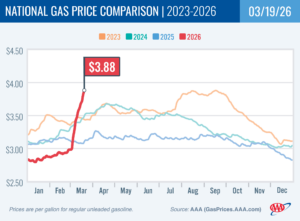
Gasoline prices have jumped nearly a dollar in just the last month. And, according to AAA, the
average national price for gasoline is nearly 80 cents more per gallon than it was this time last
year. These are some of the highest prices we’ve seen in years since the crushing inflation of
2022.
That’s why at TEA, we think it’s time to start considering a new cure for American’s chronic
gasoline price pain. This constant cycle of spiking gasoline prices chips away at the household
budgets of American families and weighs down the growth of our small businesses. The false
promises of electric vehicles as a solution has rung hollow for years. It’s time for something
new—a solution that’s groundbreaking but still grounded in common sense.
Transporting affordability.
We talk a lot here about the advantages of natural gas for electricity generation, home heating
and powering appliances in our homes. But, one of the areas with the most potential to grow
the affordable, reliable and clean advantages of natural gas is transportation.
Most people don’t realize that there are already thousands—more than 135,000 to be
exact—natural gas vehicles (NGVs) on U.S. roads today. And, there are more than 23 million
NGVs in use worldwide. According to the U.S Department Of Energy’s Alternative Fuels Data
Center, “The advantages of natural gas as a transportation fuel include its domestic availability, widespread distribution infrastructure, and reduced greenhouse gas emissions over
conventional gasoline and diesel fuels.”
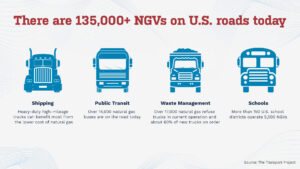
Many of these vehicles are part of government and private fleets, with natural gas powering
vehicles like buses and garbage trucks. According to the U.S Department Of Energy’s Alternative
Fuels Data Center, “The upfront costs to convert fleet vehicles to natural gas can be offset by
lower operating and maintenance costs over the lifespan of the vehicles. The payback period
depends on the fleet’s average distance traveled, required fueling infrastructure costs, and
other considerations.”’ Those same cost-savings could be applied to regular passenger cars and
trucks.
The advantages are the greatest for long-haul trucks that can benefit from the lower cost of
natural gas to travel their extensive shipping routes. Trucks transported nearly 73% of our
nation’s freight (by weight) in 2024. What a tremendous opportunity to bring affordability
directly to supermarket shelves. If those trucks were all fueled by affordable American natural
gas—and not beholden to the ups and downs of foreign oil—a huge savings could be passed on
to American consumers on all those goods.
A common-sense transition.
Now, the climate hysteria crowd would have you believe the only environmentally-friendly
transportation technology out there is electric. But, much like the failed solar installations that
were supposed to revolutionize our electrical grid, EVs increasingly seem to be a green pipe
dream.
Electric vehicle prices remain out-of-reach for many American families and individuals. The
average price of an EV in 2025 was $57,245—nearly $8,000 more than their gas-powered
counterparts. And, despite years of promises and government subsidies, the EV charging
infrastructure still just isn’t there to make electric practical for drivers around most of the
United States. On the commercial side, as The Transport Project puts it: “As battery electric
heavy-duty trucks come to market, their per unit cost is often double the natural gas
alternative…too prohibitive for most end users. Even more, the cost to build out needed on-site
fast charging infrastructure makes full scale battery electric vehicle deployment financially out
of reach for most commercial fleets.”
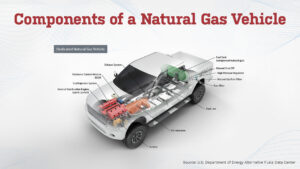
The transition from gasoline-powered vehicles to NGVs is much simpler than the failed push
toward EVs. NGVs use many of the parts as those in a traditional gasoline-powered car.
Horsepower, acceleration, and cruise speed in an NGV are all comparable to traditional
vehicles. In fact, conversion of gasoline-powered vehicles to NGVs is already an option. If we
truly wanted to make our American transportation system not only clean but also practically
affordable for everyday Americans, a look at mass-production of NGVs would be more realistic
than EVs.
Truly “green” vehicles.
If you truly want to go green and clean, natural gas is the answer. Natural gas is already the
reason that the U.S. is a world leader in lowering emissions. Increased use of natural gas for
electricity generation is the top reason for U.S. power sector emissions reductions over the past
17 years—almost double the impact compared to renewable power generation. With NGVs, we
could achieve the same victory in the transportation sector.
In the U.S., transportation is the largest contributor to greenhouse gas (GHG) emissions
accounting for 28% of the emission produced in 2022. And, 23% of those emissions came from
medium- and heavy-duty trucks. But, NGVs cut those emissions exponentially compared to
gasoline, diesel and even electric vehicles (when you account for their full life-cycle of
emissions).
According to the U.S Department Of Energy’s Alternative Fuels Data Center, “The U.S.
Environmental Protection Agency (EPA) requires all fuels and vehicle types to meet increasingly
lower, near zero, thresholds for tailpipe emissions of air pollutants and particulate matter. One
advantage to natural gas vehicles (NGVs) is their ability to meet these stringent standards with
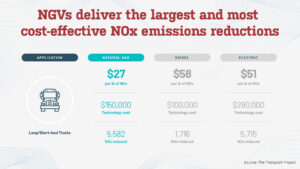
less complicated emissions controls.” Take the pollutant nitrogen oxide (Nox) as an example.
According to The Transport Project, a group that advocates for more NGV use, NGVs provide
the largest and most cost-effective reduction of NOx emissions. “The newest natural gas
engines with Near-Zero – or Zero Emissions Equivalent – technology exceed stringent new
federal NOx emissions standards.”
NGVs will ARC American Transportation.
It’s time to put a stop to this endless cycle of pain at the pump that has been burdening
Americans for decades. We need practical, common-sense solutions, not green pipe dreams to
accomplish real change.
Unlike what we’ve seen with the failed transition to electric vehicles, we could easily develop
and build NGVs for America’s transport needs in the same plants where we build gasoline-
vehicles, without the headaches of training workers on new skills and acquiring resources from
unfriendly trading partners like China. A transition to NGVs is the cure that will provide
Americans with the affordable, reliable and clean transportation choice of the future.