Permitting reform is a great start…
January 23, 2026
Permitting reform. It’s not exactly the most exciting topic in the energy world. In fact, most
everyday Americans might not even know what it means. However, it underlies an issue that
most of us do know about and that we at TEA find ourselves talking about over and over
again—energy affordability.
It has become quite common to see local and state governments and activist courts using—or
more appropriately abusing—the permitting process to stall much-needed energy projects like
pipelines. In fact, data from the U.S. Energy Information Agency shows a severe dropoff in
pipeline construction in the United States is just a few short years. These short-sighted acts
keep energy supplies from getting to the communities that need them the most, add to
unreliability issues with the electric grid and fuel sources and drive up costs for all of us.

In the last couple of weeks we’ve seen a proposal from the Environmental Protection Agency to
help stop this “regulatory overreach.” A new rule would make it harder for states and other
entities to block infrastructure projects like pipelines and hydropower dams based on the Clean
Water Act. EPA assistant administrator for water, Jess Kramer, said, “This proposed rule is the
next step in ensuring that states and tribes only utilize [Clean Water Act Section] 401 for its
statutory purpose, and not as a weapon to shut down projects.”
…The Affordable, Reliable, Clean Energy Security (ARC ES) Act is even better
Kramer goes on to say, “Our proposed rule would maximize efficiency and eliminate delays in
Clean Water Act permitting to unleash energy dominance and strengthen the economy.” If that
sounds like a good strategy, boy, have we got a bill for you—the Affordable, Reliable, Clean
Energy Security Act.
This legislation would create simple and straightforward definitions in law for what is
affordable, reliable and clean energy. Putting simple definitions behind these terms will finally
create the policy environment necessary to stop the “Green New Deal”-style games that politically-motivated extremists have been playing with our energy supply for the last several
years. Rather than the government blocking productivity and driving up costs by picking
winners and losers, this bill will set fair and sensible rules under which the best energy options
for everyday Americans win.
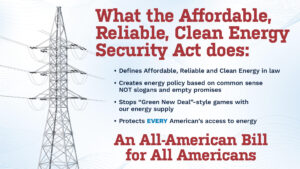
Introduced by Congressman Troy Balderson (OH-12), this bill will protect every American’s
access to their energy birthright. And, the best part, this legislation is simple and built on one of
our favorite things here at TEA—good, old-fashioned common sense, not empty green promises
and political slogans.
The ARC ES Act defines “affordable” energy as “a low cost method of producing electricity,
factoring in the full system cost of each generation source.” Often when you see cost statistics
for different energy sources, they don’t account for hidden factors—government subsidies that
go heavily to “green” energy source like wind and solar, the cost of cycling our power supply up
and down to accommodate these intermittent and unreliable power sources and added
infrastructure costs trying to get “green” energy to the people who need power. But this act
would guarantee that when the government analyzes the cost of energy going forward, it will
look at the WHOLE picture.
This is how the press release from Rep. Balderson’s office puts it: “Upon enactment, the
legislation would require relevant federal agencies—such as the Department of Energy,
Department of the Interior, and the Environmental Protection Agency—to review any actions
relating to affordable, reliable, or clean energy within 90 days and submit a report to Congress.
The bill guarantees that our most affordable and reliable energy sources, including nuclear and
natural gas, remain part of the energy mix – a crucial requirement to guarantee affordable and
reliable energy for American households and businesses. Agencies would be directed to ensure
that rulemaking, grant programs, and policies are updated to reflect and incorporate the
definitions established in this bill, and submit a final report to Congress within 180 days
detailing their implementation.”
Give the American people what they want
Nearly 60 million Americans from every single state in the nation say they consider energy
affordability when deciding how they will vote. These voters may not know all the nuances of
the how the electrical grid works. They might not know the most current stats on LNG imports
to our allies. They may not know the questionable aspects of the renewable energy supply
chain that relies on nefarious foreign governments. But, they do know that energy is a factor in
almost every aspect of our daily lives and that’s why keeping it affordable, clean and reliable is
so important.

Elected representatives looking for an issue that really connects to their constituents’ daily lives
should take note. The ARC Energy Security Act is THE solution and exactly the kind of policy
these Energy Affordability Voters are looking for from their leaders.
In an op-ed from last month, Karen Harbert, CEO of the American Gas Association, said:
“Permitting reform will empower the economy and get the heavy hand of bureaucracy out of
the way. With Congress, we can drive economic progress for this country, secure affordable
energy for homeowners and businesses and win the race for a competitive economic
advantage. If we streamline our outdated permitting processes, we can provide a brighter
future for American families, safeguard our national security, lower costs for American
households and build our economy of the future. Imagine that.”
At TEA, we can absolutely imagine that. And, we can imagine even more with the passage of
the ARC ES Act. Energy affordability underlies nearly every economic issue facing American
families and business. It keeps the costs of manufacturing and shipping low. It fuels reliability
that keeps our households safe and healthy and our workplaces productive. It supports
economic growth and job creation for all. There is no greater issue that our leaders in Congress
and the White House can tackle to ensure that we continue to make America great for everyday
families now and in the future.