
Summer heat is no joke. Neither is grid reliability
July 14, 2025
Summer heat is no joke.
If you’re anything like us at TEA, summer is a time of fun in the sun for you and your families. Swimming, barbeques, vacations all have us appreciating time off to get outside and enjoy the weather. But, this season has as many extremes as the winter months, and the need for reliable energy during the summer is no joke.
We often think of the need for reliable and affordable access to electricity and other energy sources during the long, cold months of winter. As we should. Home heating during cold weather is an absolute necessity and can be one of the costliest bills a homeowner faces. And, losing power from ice storms and other winter weather can create life or death situations.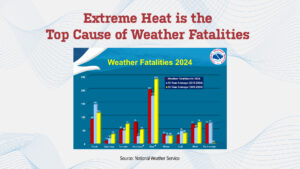
But, according to the National Weather Service, even considering the starkness of winter, extreme heat is by far the top cause of weather-related fatalities. In 2024, extreme heat killed more than twice as many people as any other weather event—and it killed more than three times as many people as extreme cold and other winter weather. If the power goes out and the air conditioning turns off, during a summer thunderstorm or even worse if your home experiences blackouts or brownouts from an overextended and unreliable electrical grid, it can create a truly dangerous situation for many Americans.
Blackouts shouldn’t be the summer norm.
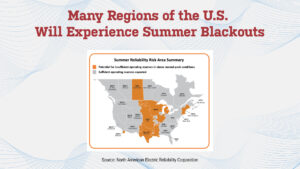
Unfortunately, that has increasingly been an issue many American families and businesses face every summer. The North American Electric Reliability Corporation (NERC) says the summer demand for electricity will increase at more than double the rate it did from 2023 to 2024. Projections show the U.S. will need 10 gigawatts more electricity during this summer than last. That’s the amount of power it takes to keep the lights on in approximately 10 million homes. As a result, NERC predicts that many regions in the use will experience summer blackouts.
Unsurprisingly, as TEA has been predicting for years, NERC cites the rush to so-called green energy as one of the reasons for this grid instability. Wind and solar are not “baseload” energy sources. They just simply don’t work around the clock, and battery storage technology still lags after years of promises that it would be a fix-all. So, when unreliable renewable sources go down, it destabilizes the whole system. Add to that the rush to shut down traditional natural gas- and coal-fired power plants, and we’ve created an infrastructure that simply can’t keep up with exponentially increasing demand.
The potential for summer blackouts led to Energy Secretary Chris Wright issuing an emergency order in May, in an attempt to get ahead of the crisis. Wright’s order ensured that a 150-megawatt coal plant in Michigan stays online to ensure the Midwest has a reliable power source to get through the upcoming hot and dry summer.
As Wright put it: “Today’s emergency order ensures that Michiganders and the greater Midwest region do not lose critical power generation capability as summer begins and electricity demand regularly reach high levels. This administration will not sit back and allow dangerous energy subtraction policies threaten the resiliency of our grid and raise electricity prices on American families. With President Trump’s leadership, the Energy Department is hard at work securing the American people access to affordable, reliable, and secure energy that powers their lives regardless of whether the wind is blowing, or the sun is shining.”
AC vs. AI.
The Trump Administration’s shift back to maintaining traditional energy sources that can power a reliable electrical grid through the sweltering summer heat is a huge step in the right direction. But, unless we stay the course and invest in reliable energy sources like natural gas, nuclear and coal, these summer power emergencies aren’t likely to end anytime soon because a wave of demand is coming.
There’s many reasons for the increasing drain on our electricity grid. As we’ve discussed here many times, the surge of artificial intelligence and the data centers that power it is fueling a huge new demand for electricity that we are only beginning to realize and address. But, on a global scale, keeping up with the growing demand for air conditioning around the world is likely to be an even bigger challenge. Worldwide, both data centers and air conditioning are expected to triple their draw on electricity over the next decade.
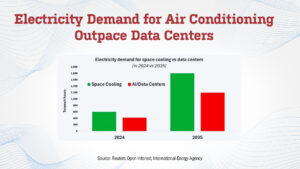
Reuters Open Interest reports that global electricity demand from data centers will rise by roughly 800 terawatt hours (TWh) by 2035, from around 416 TWh in 2024—enough power for around 75 million American homes for a year. But, the worldwide demand for cooling will rise by around 1,200 TWh by 2035—nearly as much electricity as the entire Middle East uses per year.
Reuters: “In 2022, around 36% of all households were estimated to possess some air conditioning equipment, according to the IEA. By 2035, that share is expected to jump to 50%, and then to 60% by 2050. To power that expanding footprint, the installed capacity of cooling equipment is set to surge from around 850 gigawatts (GW) in 2022 to 1,750 GW by 2035, and to 2,700 GW by 2050.”
This demand for energy to power space cooling is not limited to the developing world, though. In New York City, more than 500 people died heat-related deaths over the five-year period from 2018 to 2022.
“Build, baby, build” is cool.
While the number of heat-related deaths in New York City is miniscule compared to cities in India or other developing nations, the fact that this still occurs underscores how important energy affordability and reliability are. We live in an era of technology surging and achieving things we only dreamed of just a few short years ago. However, even in America’s cities, people still face true life or death consequences of lack of access to energy they can afford and count on to be there on our hottest days—and that simply shouldn’t happen.
Thankfully, we’re already seeing smart, common-sense leadership on this issue. Recently, Louisiana became the first state in the nation to embrace legislation that supports and protects affordable, reliable and clean energy for the citizens of Louisiana—a state that is a perfect example of the need for energy sources that we can count on in the sweltering months of summer.
Louisiana gets it, and now we must follow through on Chris Wright’s promise to stop the era of “energy subtraction” and go back to doing what works for Americans and their energy needs across the rest of the U.S. We need to “Build, baby, build” to strengthen and expand our electrical grid and invest in traditional energy production at power plants that can operate around the clock, rain or shine. And, we need to embrace Affordable, Reliable and Clean Energy Security (ARC-ES) legislation at the state and federal level, to ensure that those energy sources are explored, produced and delivered to all Americans for years to come.