The Dirty Secret Behind ‘Green’ Energy Subsidies
September 7, 2025
We’ve said it before, and we’ll say it again.
We know, you’ve likely already heard us railing against subsidies for renewable energy sources like wind and solar. But, there is a reason we keep bringing it up: so-called “green” energy subsidies are in direct opposition to the Affordable, Reliable and Clean Energy Security that American families and businesses need and deserve to be safe and successful.
Here are just a few of the important facts about these subsidies that you should know.
What even is a subsidy?
It’s one of those words that gets thrown around a lot, but really what does it even mean? Well, short answer, it means YOUR money.
At its most basic, tax-preparer H&R Block defines a subsidy as “a payment … from the government, usually in the form of a targeted tax cut.” But, as we all know, the government’s money comes from us. So, effectively, a subsidy is the government taking money from YOU, the taxpayer, to fund a tax break for someone else. And, since we know, these subsidies don’t actually make energy more affordable, you’re basically paying for renewable energy twice—once on your tax bill and again on your electric bill. In bigger picture economic effects, subsidies take money from other necessary government programs and add to our national debt.
A big investment with little return.
According to the Institute for Energy Research, “Federal subsidies to support renewable energy formed nearly half of all federal energy-related support between fiscal years 2016 and 2022. Traditional fuels (coal, natural gas, oil and nuclear) received just 15 percent of all subsidies between FY 2016 and FY 2022, while renewables, conservation and end use received a whopping 85 percent. Renewable subsidies more than doubled between FY 2016 and FY 2022, increasing to $15.6 billion in fiscal year 2022 from $7.4 billion in fiscal year 2016 (both in 2022 dollars). Federal subsidies and incentives to support renewable energy in fiscal year 2022 were almost 5 times higher than those for fossil energy, which totaled $3.2 billion in subsidies.”
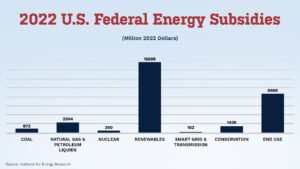
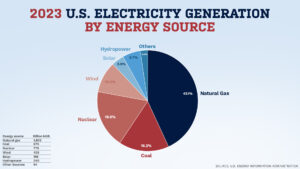
But American taxpayers aren’t getting a return on their investment. Wind and solar energies are only provide 14% of the electricity produced in the U.S. In contrast, nuclear power receives only a fraction of the handouts, but contributes 18.6 % of the electricity produced in the U.S. Traditional hydrocarbon sources also receive much less taxpayer support while producing a 60% majority of our nation’s power.
“Green” subsidies are nothing new…and they’ve never worked.
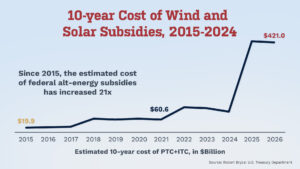
Before much of the green money dumped into the Inflation Reduction Act was repealed, those numbers were even bigger. As energy author Robert Bryce points out, from 2015 to 2024 the 10-year cost of wind and solar subsidies called the investment tax credit (ITC) and production tax credit (PTC) increased from just under $20 billion in annual spending to $421 billion. Bryce: “Between 2025 and 2034, the agency expects the ITC to cost $131.4 billion and the PTC to cost $289.6 billion. That $421 billion total is a 21-fold increase since 2015 and a nearly 7-fold increase since 2021, the year before the IRA became law.”
Even if you somehow believe that billions and billions of taxpayer dollars being dumped into “green” programs is appropriate, the green-at-any-cost PR campaign around most renewable subsidies means these projects are almost never properly vetted. One of the first examples, the Solyndra scandal under then-President Barack Obama that cost taxpayers nearly $600 million, is nearly 20 years-old. There’s a decades-long history of government-funded renewable energy and electric vehicle projects going belly up after getting taxpayer dollars with little oversight. See for just a few examples: A123 Systems, Fisker, Crescent Dunes, Ivanpah.
All that money hasn’t made us clean, reliable or secure.
And, for all that money, renewable energy subsidies have delivered little when it comes to clean, reliable energy security either.
The U.S. has in fact become a world leader in reducing emissions, despite, not because of the money dumped into renewable energy. That accomplishment is largely due to the increased use of clean-burning natural gas to produce our electricity. Since 2005, natural gas used for power generation has cut nearly double the emissions that renewable sources like wind and solar have.
Recently, the North American Electric Reliability Corporation (NERC) cited the rush to so-called green energy as one of the reasons for increasing electrical grid instability. Wind and solar are not “baseload” energy sources. They just simply don’t work around the clock, and battery storage technology still lags after years of promises that it would be a fix-all. So, when unreliable renewable sources go down, it destabilizes the whole electrical system. That costs our businesses money and creates inconvenient and sometimes downright dangerous situations in our households.
And, just at a time when Americans are finally enjoying true energy security and independence after decades of dependence on untrustworthy foreign governments for our energy, wind and solar energy place us right back at square one. We rely heavily on China for rare earth imports necessary for wind, solar and electric vehicles—the entire world does in fact. China has 70% of the world’s rare earth mining and has a stranglehold on 90% of rare earth refining capacity. From 2020 to 2023, China accounted for 70 percent of U.S. rare earth imports. In China, these mines have poisoned water and soil and caused “cancer villages” in impoverished areas. Other necessary resources like cobalt come from places like the Democratic Republic of the Congo, where mines have been found to be unsafe and employ child labor.
The facts are right there. Americans need Affordable, Reliable, Clean Energy Security, and they just won’t get it if we keep pretending that renewable energy sources can meet our energy needs and power this nation. It’s a pipe dream that Americans can’t live with and certainly shouldn’t have to pay for.