
America UPDATE the Jones Act NOW
April 5, 2026
In case you missed it, an obscure, century-old shipping law is underlining what TEA has been
saying for years. To ensure America’s energy independence, we need to tap America’s
abundant, domestic energy resources. We need to refine and process that energy here in
America with the most innovative techniques to produce it cleanly and reliably. And, we need
to invest in and build necessary American energy infrastructure to transmit and transport those
energy resources from American producers to the American communities that need them.
Seems like a common-sense proposition, no? Well, get this. In recent years, American
communities from Boston to Puerto Rico have imported Russian natural gas to meet their local
energy needs. And, one reason for that is because a federal law blocks shipping goods between
two U.S. ports by a foreign shipping vessel.
What is the Jones Act?
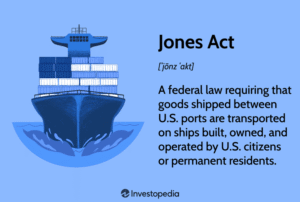
The Jones Act—or as its officially named the Merchant Marine Act of 1920—sounds like good
“Made in America” policy on paper. The Act “mandates American-made, owned, and operated
ships for transporting cargo between domestic ports.” The law was meant to bolster the U.S.
shipping industry after World War I, when many American merchant ships were destroyed by
German U-boats. Even though we live in a vastly different world today, it remains the law of the
land.
So, what’s the problem? There just aren’t that many ships that meet those criteria and the ones
that do are very expensive to build. And, when it comes to energy the problem is even bigger.
According to the American Enterprise Institute (AEI), “Jones Act restrictions make it
economically infeasible for New England, the West Coast, and other domestic markets to be
served by oil tanker shipments from the Gulf Ports and make it very costly for West Coast markets to be served by shipments from Alaska. The situation with respect to liquefied natural
gas (LNG) is even more dire. There is currently not a single Jones Act LNG vessel capable of
shipping natural gas from the Gulf to ports in either New England or US territories such as
Puerto Rico.”
Mind-blowing as it may be, those are the facts. There is not a single ship in existence owned by
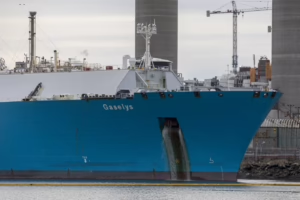
an American company that can transport American LNG between American ports. As the Wall
Street Journal put it, “That means Puerto Rico effectively is barred from importing gas from LNG
terminals in Georgia or Louisiana. As a result, it apparently turned to Siberia. The same
happened two winters ago in New England, where gas is short due to a lack of pipeline capacity.
A tanker of Russian gas was unloaded in Boston. How is this an “America First” policy?”
The Jones Act has found its way into the news recently when President Trump suspended the
act for 60 days. White House Press Secretary Karoline Leavitt tweeted: “President Trump’s
decision to issue a 60-day Jones Act waiver is just another step to mitigate the short-term
disruptions to the oil market as the U.S. military continues meeting the objectives of Operation
Epic Fury. This action will allow vital resources like oil, natural gas, fertilizer, and coal to flow
freely to U.S. ports for sixty days, and the Administration remains committed to continuing to
strengthen our critical supply chains.”
If not by sea, then by land
The reality is there’s a much easier way to get American LNG and oil from one part of the
country to the next—pipelines. Some of the very communities, especially in the Northeast
region, that have purchased LNG from Russian tankers to heat their homes in the winters have
created this problem for themselves.
Pipeline projects like the Atlantic Coast Pipeline, PennEast, and Northeast Supply Enhancement
have been crushed under “regulatory hurdles, legal challenges, and environmental opposition”
in New York and other states in the region. In the Northeast, the Constitution Pipeline has
recently found surprising bipartisan support, but only after years of green-at-any-cost leaders in
the region blocking the necessary infrastructure to bring affordable natural gas to New England
families. As a result, the region has paid astronomical prices for home heating. The proposed
125-mile pipeline from Pennsylvania’s Marcellus Shale to upstate New York aims to boost
natural gas supply to Connecticut and, by extension, Massachusetts, Rhode Island, and New
Hampshire. If approvals go through, construction could begin in late 2026, with the target in
service near the third quarter of 2027.
Hopefully, that’s a trend that continues. Pipelines create thousands of jobs. They bring lower
and more consistent energy prices for households and businesses. They bring reliability in
regions of the U.S. with some of our coldest and most volatile winters. For far too long, this
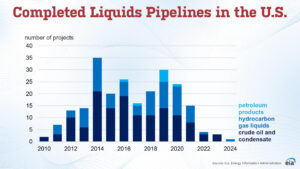
extremely necessary infrastructure has been under attack, and it’s taken its toll. According to
U.S. Energy Information data, completed pipelines that move petroleum liquids have declined
exponentially since peaking in 2014. In the recent years, only a handful of projects have been
completed each year.
According to the U.S. Department of Transportation: “The nation’s more than 2.6 million miles of pipelines safely deliver trillions of cubic feet of natural gas and hundreds of billions of
ton/miles of liquid petroleum products each year. They are essential: the volumes of energy
products they move are well beyond the capacity of other forms of transportation. It would
take a constant line of tanker trucks, about 750 per day, loading up and moving out every two
minutes, 24 hours a day, seven days a week, to move the volume of even a modest pipeline.
The railroad-equivalent of this single pipeline would be a train of 225, 28,000 gallon tank cars.”
In America, we build
The Jones Act has been waived many times before. In this case, it is for the current military
action in Iran. Other times it has been for natural disasters like hurricanes. With such frequent suspensions of the law, there does seem a valid argument for its repeal, at least when it comes
to transporting energy resources. But that’s a debate for another time and place.
Right now, we need to pass energy laws like the Affordable, Reliable and Clean Energy Security
Act (ARC ES) that prioritize common-sense ways to bring affordable energy to American
families. Perhaps rather than debating a hundred-year-old maritime law, we should be looking
at policies that encourage American shipbuilding, especially ships that could transport
American LNG to the American communities and our allies that need it. Even more importantly
we should invest in proven energy infrastructure like pipelines that serve the same purpose
cheaper and more efficiently. Whether its pipelines, American LNG ships or some other
infrastructure, the real solution—and opportunity—is the same mantra TEA has been repeating
all along: build, baby, build.