Voting for the “cure” that caused the disease
November 17, 2025
“Clean energy could become a huge political winner” – Vox, November 7, 2025
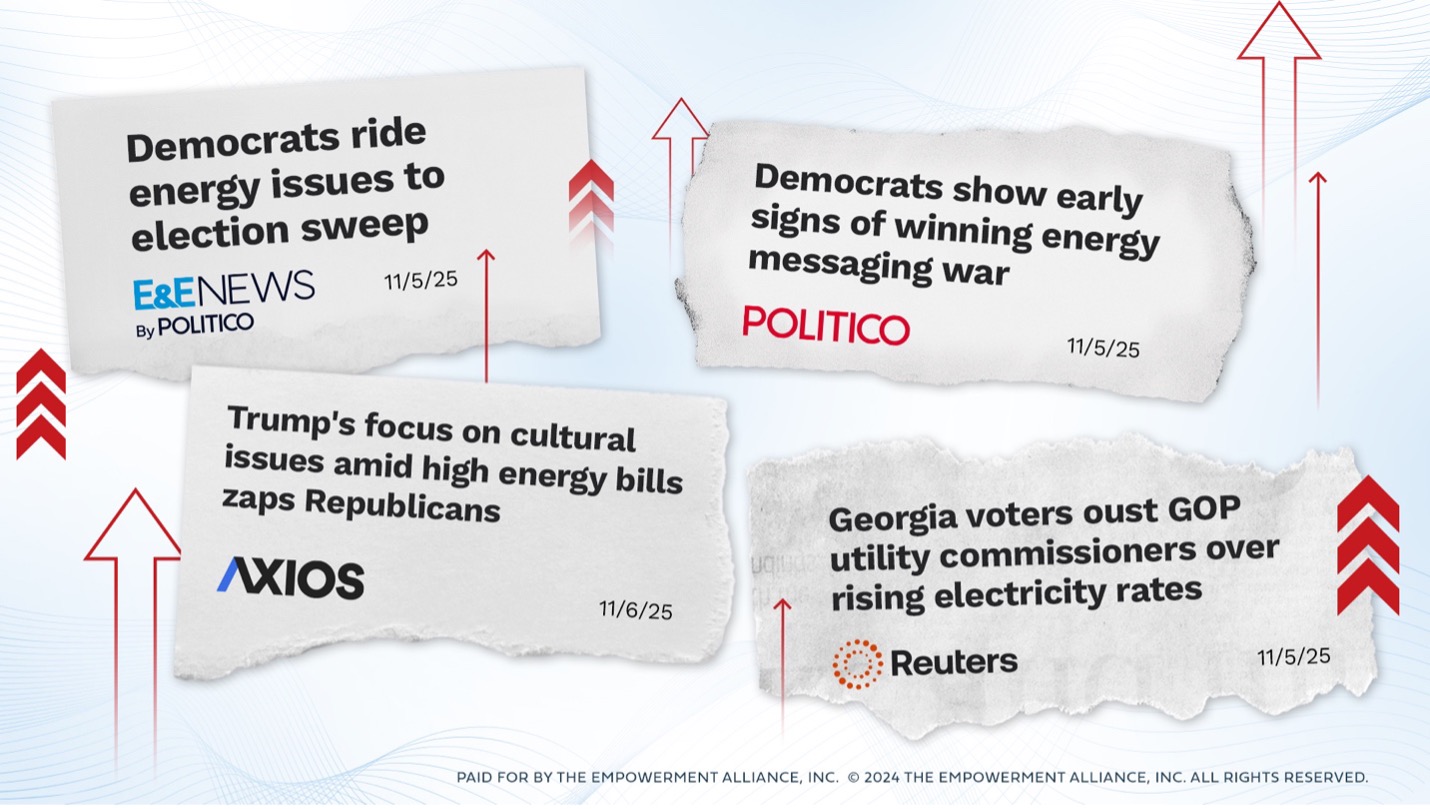
We’ve seen a flurry headlines like this following the recent off-year elections, saying that green-at-any cost candidates captured a winning message to voters on energy affordability. In the governors’ races in Virginia and New Jersey, both victorious candidates highlighted rising electricity bills in their campaigns and promised—you guessed it—more wind and solar power to address rising costs.
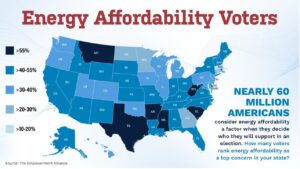
Now, it’s not surprising that voters were moved by energy affordability issues. As TEA has been saying for years, energy affordability is a very real and personal issue for everyday Americans across the country. Nearly 60 million Americans rank the issue of energy affordability among their considerations when choosing a candidate to support at the polls. We call them “Energy Affordability Voters” and they made their voices heard in these off-year elections.
But, the “cure” these voters are supporting isn’t just worse than the disease—it’s what caused it. And, the truly scary part of these wins for expensive and unreliable green energy is that those misleading campaign messages are likely to be repeated next fall during midterm elections when even more is at stake.
Betting on more politicized, taxpayer-funded green schemes will only cost American families and businesses more and take us backward. We must stop the yo-yoing extremes with our energy policy.
Energy costs are up because of the subsidies under Biden
Renewable energy is simply not affordable energy. It’s energy that you pay for again and again and again. You pay for it in taxes to fund the subsidies that prop it up. You pay for it in your electric bill. And, you pay for it when it’s intermittency and unreliability drive up energy costs across the board.
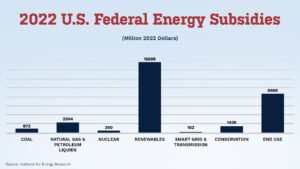
Exponentially higher federal subsidies going to renewable energy sources over traditional energy sources like natural gas, nuclear and oil is nothing new. According to the Institute for Energy Research, “Federal subsidies to support renewable energy formed nearly half of all federal energy-related support between fiscal years 2016 and 2022. Traditional fuels (coal, natural gas, oil and nuclear) received just 15 percent of all subsidies between FY 2016 and FY 2022, while renewables, conservation and end use received a whopping 85 percent. Renewable subsidies more than doubled between FY 2016 and FY 2022, increasing to $15.6 billion in fiscal year 2022 from $7.4 billion in fiscal year 2016 (both in 2022 dollars). Federal subsidies and incentives to support renewable energy in fiscal year 2022 were almost 5 times higher than those for fossil energy, which totaled $3.2 billion in subsidies.”
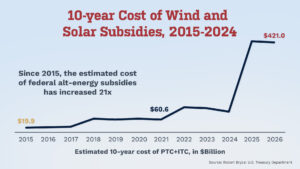
After the Biden Administration’s huge handouts to solar and wind in the Inflation Reduction Act (IRA), those numbers grew even more. As energy expert Robert Bryce points out, from 2015 to 2024 the 10-year cost of wind and solar subsidies called the investment tax credit (ITC) and production tax credit (PTC) increased from just under $20 billion in annual spending to $421 billion. Before provisions of the IRA were repealed, between 2025 and 2034, the agency expected the ITC to cost $131.4 billion and the PTC to cost $289.6 billion. Bryce: “That $421 billion total is a 21-fold increase since 2015 and a nearly 7-fold increase since 2021, the year before the IRA became law.”
And, all those years of subsidies haven’t lowered electricity costs for everyday Americans one bit. According to the Energy Information Administration, the retail price of electricity in the United States has risen at a consistent pace over the last two decades. In 2001, Americans were paying an average 8.58 cents per kilowatt hour for residential electricity. In 2024, that price was 16.48 cents per kilowatt hour, nearly doubling in just over 20 years. And, the biggest uptick was from 2021 to 2024. During that time, there was a 21% percent increase in the average price American families paid for electricity, and that happened during the exact same period that Biden’s IRA green energy slush fund went into place.
So, if the green energy subsidy game hasn’t brought down electricity costs over all those years, why in the world would we vote for more? We need common-sense energy policies that we can all agree on, that put true affordability—not green schemes—first while balancing the needs for reliable and clean energy as well.
There’s a bill for that.
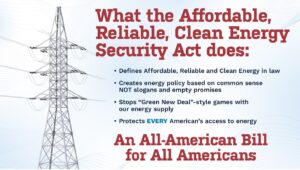
Thankfully, there’s legislation that does just that—the Affordable, Reliable, Clean Energy Security ACT.
The Affordable, Reliable, Clean Energy Security Act would create simple and straightforward definitions in law for what is affordable, reliable and clean energy. Putting simple definitions behind these terms will finally create the policy environment necessary to stop the “Green New Deal”-style games that politically-motivated extremists have been playing with our energy supply for the last several years. Rather than the government blocking productivity and driving up costs by picking winners and losers, this bill will set fair and sensible rules under which the best energy options for everyday Americans win.
The Affordable, Reliable and Clean Energy Security Act is the law that we’ve been waiting to see out of Washington, D.C. We’ve seen the success of such laws in states like Louisiana that have embraced the ARC ES principles.
Now, we need ARC ES federal legislation to pass before more politicized misinformation can lead to costly, unreliable energy policies all across the country—not in just a few states. ARC ES puts affordability for everyday Americans first and that’s why it’s common-sense legislation that both sides can support. An All-American Bill for All Americans!