

Affordable and Abundant: Natural Gas Is America’s Ace In The Hole
April 2, 2026
Need to know
- Check out TEA’s website for the latest in energy news and opinion.
- TEA Takes: Off-grid data centers will help protect ratepayers, but codifying ARC-ES would do even more.
- Michigan residents to get largest electricity rate hike in decades.
- The Strait of Hormuz energy crisis offers another reason to repeal the Jones Act.
- Trump DOJ claims win as Michigan sidesteps climate lawsuit playbook.
- Affordability crunch pushing Democrats to scale back climate ambitions.
- California’s fossil fuel phaseout has left it vulnerable to the Iran oil shock.
- U.S. panel votes to exempt Gulf of Mexico drilling from Endangered Species Act.
- ALEC releases Energy Affordability Report, 5th edition.
ARC in the states
- The Idaho legislature voted in support of state energy sovereignty. Idaho’s long-term reliability and grid stability require secure, dispatchable base load generation capable of continuous output of weather variability, including advanced and conventional nuclear energy technologies, hydroelectric plants and natural gas generation.
RealClear
- American Coal as A Strategic Imperative.
- Opinion: Quibbling over carbon metrics.
Common Sense
PRICES HOLDING STEADY: US natural gas has reacted very differently than oil to disruptions caused by the Iran war, holding steady around $3 per million British thermal units because of the country’s large supply.
Why it matters: Oil is sold on a global market. Prices rise and fall globally. Gas markets are local, and a country’s natural gas price depends heavily on whether it has domestic supplies or must import gas.
The reason the price is so low and stable in the United States is the combination of hydraulic fracturing and directional drilling that revived domestic oil and gas production after nearly 40 years of decline. The shale drilling boom it created opened up vast oil and gas reserves and turned the United States into the world’s largest producer of oil and natural gas.
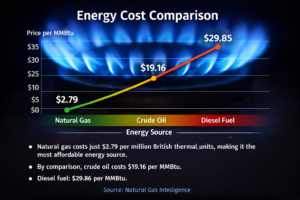
The price of natural gas is $2.79/million British Thermal Units, compared with one barrel of crude oil at $19.16/MMBtu. Diesel fuel is $29.85/MMBtu.
That’s further proof that natural gas is the most affordable energy source.
Consider:
- In other regions of the world, natural gas prices have skyrocketed as Iran retaliates by bottling up energy supplies in the Persian Gulf and attacking production sites. Liquefied natural gas prices in Asia have risen more than 90 percent since the bombing started.
- That isolation has kept natural gas prices from joining gasoline as a headache for President Donald Trump and congressional Republicans in their effort to maintain control of Congress in November’s midterm elections.
- It’s also kept electricity prices — which have climbed in recent years — from becoming more of an issue.
TEA also knows that passage of ARC Energy Security legislation would further guarantee all energy be affordable and reliable, during times of peace and in times of global conflict. The goal is to unleash American energy dominance, ensure our energy independence and support a common-sense approach that guarantees affordable, reliable and clean energy based on evidence and science rather than “Green New Deal” political agendas.
The White House believes the current energy situation illustrates the advantage of the country’s oil and natural gas production.
“So, we’re on an energy island here in the U.S.,” said Karen Harbert, CEO of the American Gas Association, “and that’s good for the economy and good for customers.”
Bottom line: Middle East conflict underscores a simple truth: abundant domestic natural gas is essential. We have a century’s supply — and the technology to use it. That should reassure consumers.
Nonsense
CAN’T GET NO RELIEF: At a time when Americans are already struggling with rising electricity bills, 120 House Democrats have introduced the so-called “Energy Bills Relief Act.” The name sounds nice, but in reality, this bill will deliver the opposite of relief, this Power The Future piece highlights.
Why it matters: The bill aims to expand renewable energy, making our energy grid unreliable and more expensive. Wrong choice.
Consider:
- Renewable energy sources, such as wind and solar, are intermittent.
- They only generate electricity when conditions allow, making them incapable of providing the consistent, on-demand energy needed to keep the grid stable.
- The cost argument is just as misleading. While proponents claim renewables are “low-cost,” they omit the fact that they rely heavily on subsidies. Those costs don’t go away; they appear in higher utility bills for families and businesses.
Meanwhile, in Connecticut a renewable energy measure could cost residents millions more in electric bills.
House Bill 5340 would expand and restructure several of Connecticut’s renewable energy programs. Supporters describe it as a step forward for clean energy and broader access to solar power. Critics, including utilities, regulators, and energy experts, warn the bill could increase costs while weakening existing safeguards that help keep prices in check.
Estimates put the total cost exposure from the bill at about $11 billion.
It seems the green-at-any-cost crowd never cares about the little guy, aka the consumer, when pushing their schemes. They often fail to cite facts, relying more on preying on consumer fears than reality.
Americans deserve policies that genuinely reduce costs and improve reliability. That means investing in proven, reliable energy sources and making sure we can produce energy here at home.
Bottom line: The “Energy Bills Relief Act” may sound consumer-friendly, but it’s driven by green-at-any-cost ideology — putting affordability and reliability at risk.
A look ahead
Nothing on the calendar during Easter week break.
Quote of the week
“Here we are in the United States where we produce over 13 million barrels of oil every single day. If we were in the same position that we were in 10 years ago when we were only producing 5 million barrels a day, prices would have spiked significantly higher.”
— American Petroleum Institute President Mike Sommers
— American Petroleum Institute President Mike Sommers