Gas-fueled onsite power the best path for data centers
September 3, 2026
Need to know
Need to Know
- Check out TEA’s website for the latest in energy news and opinion.
- TEA Takes: Guaranteeing affordable, reliable energy would help tackle our $40 trillion debt.
- California sues over Trump offshore wind cancellation.
- Chevron to invest $7B in Venezuela, doubling production.
- California legislature approves plug-in solar legislation.
- Solar overtakes coal as the biggest power source in China.
- US LNG exports rose 23% in the first half of 2026.
- US pushes looser approach to AI regulation, while EU wants new law.
RealClear
- Opinion: Foreign Lawfare Threatens Transatlantic Energy Security.
Common Sense
MARKET OPPORTUNITY: Energy Transfer is quietly becoming one of the biggest natural gas suppliers to AI data centers.
Consider: The company realizes that gas-fueled onsite power remains a faster solution than waiting on the grid.
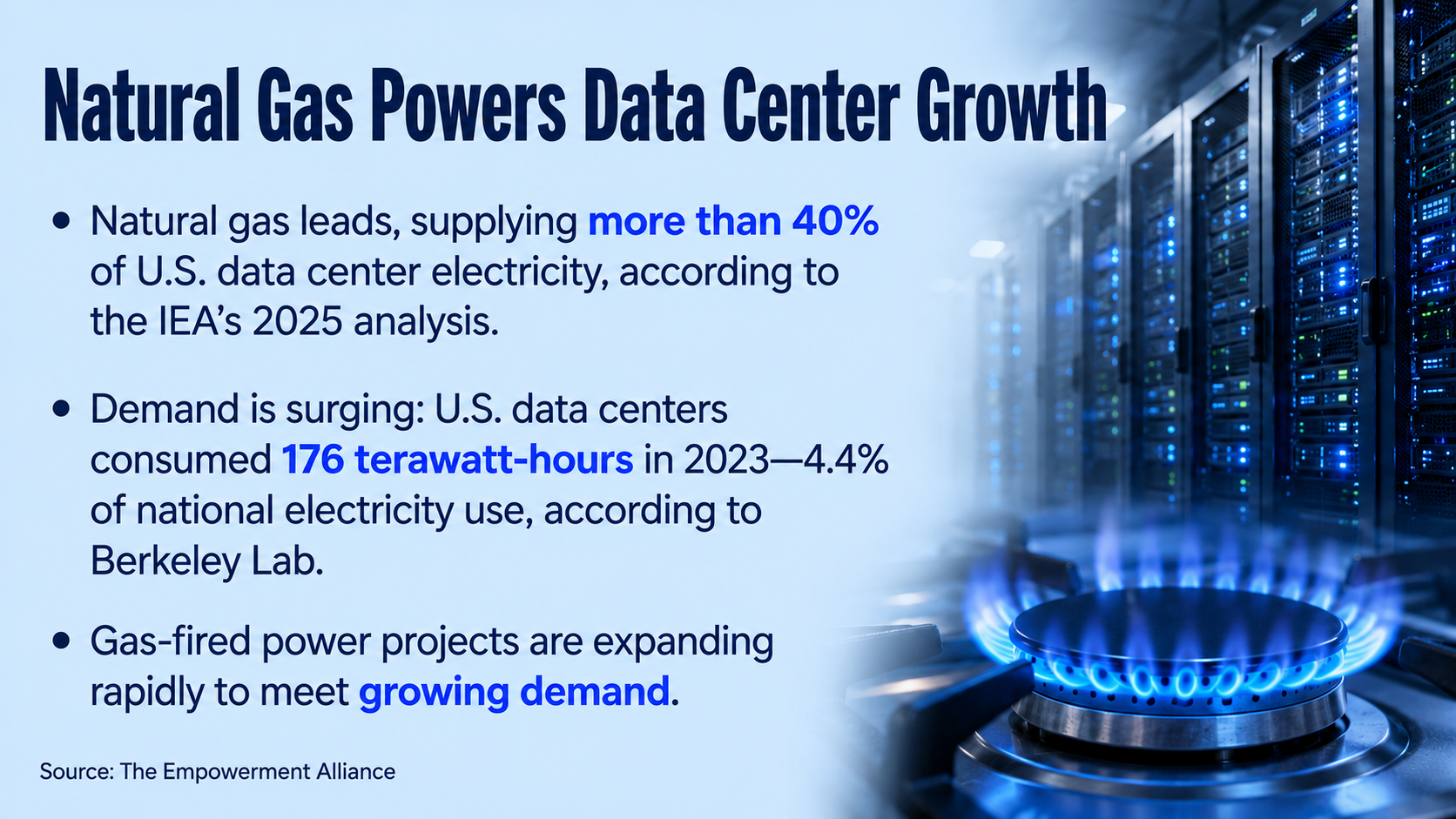
Natural gas already leads, supplying more than 40% of U.S. data center electricity, according to the IEA’s 2025 analysis. More gas-fired power projects are expanding rapidly to meet growing demand.
Why it matters:
- The pipeline giant is in a strong position to cash in on the AI power boom.
- Data centers need lots of power, and they need it quickly. The country’s electric grid can’t keep up with the load requirements or the need for speed.
- As a result, natural gas is becoming a critical solution to the AI power problem via on-site power from gas turbines and fuel cells.
Data centers are turning to Energy Transfer as their gas supplier of choice. Its extensive gas infrastructure includes nearly 107,000 miles of pipelines linking supply sources to demand centers. It has signed several deals to supply gas to support AI data center demand.
One of its biggest deals is with cloud giant Oracle. It also signed a 20-year deal with Entergy to provide at least 250,000 MMBtu/d of gas starting in December 2028 to the Louisiana integrated energy company.
This is a prime example of why federal and state laws are needed, such as ARC Energy Security, allowing traditional energy sources, primarily natural gas and nuclear, to remain competitive. There simply is no better means to deliver dispatchable power.
Bottom line: Leaning into the AI and data center boom is a smart move. Affordable and reliable energy is positioned to help power this technology for decades.
Nonsense
PLAYING THE BLAME GAME: Gov. Kathy Hochul recently attacked President Trump for driving up energy prices for New Yorkers. The governor warned that Trump’s trade dispute with Canada could lead to higher costs for New York residents after Ontario Premier Doug Ford threatened to retaliate by cutting electricity exports to the United States.
Why it matters: New York is not the only Democrat-run state sacrificing its citizens on the altar of climate change. It’s all about the policy.
Look no further than Hochul and her predecessor, Andrew Cuomo.
- They have waged war against those same fossil fuels (which supply some 60 percent of the nation’s electricity) and that has resulted in a spike in electricity prices.
- And New York residents are paying a whopping 62% more for electricity than the national average.
Consider: Blue states generally have higher energy costs than red states, according to data compiled by the Institute for Energy Research. In 2011, average electricity prices in blue states were 44 percent higher. By 2025, the gap had widened to 61 percent.
The growing disparity points to policy choices — not geography. If regional factors were primarily responsible, the gap would likely have remained relatively stable.
The sharpest increases have occurred in places such as California and New England. California has become a poster child for the soaring costs of a grid increasingly reliant on wind, solar and battery storage.
New England, meanwhile, has shunned abundant, relatively clean natural gas. Some officials are now retreating from harmful climate policies—not because they’ve had a change of heart, but because they fear losing elections.
The growing disparity points to policy choices — not geography. If regional factors were primarily responsible, the gap would likely have remained relatively stable.
The sharpest increases have occurred in places such as California and New England. California has become a poster child for the soaring costs of a grid increasingly reliant on wind, solar and battery storage.
New England, meanwhile, has shunned abundant, relatively clean natural gas. Some officials are now retreating from harmful climate policies—not because they’ve had a change of heart, but because they fear losing elections.
Bottom line: Before voting in November, research each candidate’s energy record. Your choice could be reflected in your electricity bill.
Midterm spotlight
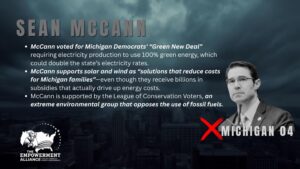
Michigan’s 4th Congressional District: Candidates Give Sharply Different Visions for Energy Affordability.

A look ahead
FERC Open Meeting: On Thursday, September 10, the Federal Energy Regulatory Commission will hold an Open Meeting of the Commission.
Quote of the week
“I think this is a win. It’s a generational win for Americans because it is [going to] lead to a generation of low prices.”
— Oil trader Phil Flynn
— Oil trader Phil Flynn